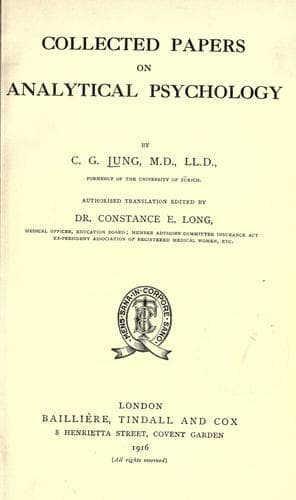
Collected Papers on Analytical PsychologyJung, C. G. (Carl Gustav)
Science
Collected Papers on Analytical Psychology
Jung, C. G. (Carl Gustav)
Psychoanalysis
Anna once quarrelled with her younger sister, and the latter exclaimed
angrily, "I will kill you." Whereupon Anna answered, "When I am dead you
will be all alone; then you will have to pray to God for a live baby."
But the scene soon changed: Anna was the angel, and the younger sister
was forced to kneel before her and pray to her that she should present
to her a living child. In this way Anna became the child-dispensing
mother.
Oranges were once served at table. Anna impatiently asked for one and
said, "_I am going to take an orange and swallow it all down into my
stomach, and then I shall get a baby._" Who does not think here of
fairy tales in which childless women become pregnant by swallowing
fruit, fish, and similar things?[148] In this way Anna sought to solve
the problem _how the children actually come into the mother_. She thus
enters into a formulation which hitherto had not been defined with
so much clearness. The solution follows in the form of an _analogy_,
which is quite characteristic of the archaic thinking of the child.
(In the adult, too, there is a kind of thinking by metaphor which
belongs to the stratum lying immediately below consciousness; dreams
bring the analogies to the surface; the same may be observed also in
dementia præcox.) In German as well as in numerous foreign fairy tales
one frequently finds such characteristic childish comparisons. Fairy
tales seem to be the myths of the child, and therefore contain among
other things the mythology which the child weaves concerning the sexual
processes. The spell of the fairy tale poetry, which is felt even by
the adult, is explained by the fact that some of the old theories
are still alive in our unconscious minds. We experience a strange,
peculiar and familiar feeling when a conception of our remotest youth
is again stimulated. Without becoming conscious it merely sends into
consciousness a feeble copy of its original emotional strength.
The problem how the child gets into the mother was difficult to solve.
As the only way of taking things into the body is through the mouth, it
could evidently be assumed that the mother ate something like a fruit,
which then grows inside her. But then comes another difficulty, namely,
it is clear enough what the mother produces, but it is not yet clear
what the father is good for.
What does the father do? Anna now occupied herself exclusively with this
question. One morning she ran into the parents' bedroom while they were
dressing, she jumped into her father's bed, lay face downwards, kicked
with her legs and called at the same time, "_Look! does papa do that?_"
The analogy to the horse of "little Hans" which raised such disturbance
with its legs, is very surprising.
Public-domain text, read in full here on John Shaqi.
Reviews
Reviews
No reviews yet
Be the first to share your thoughts on this work.
Elsewhere in the archive
Join the Discussion
Join the discussion
Sign in to leave a comment or review.
Sign InorCreate an account