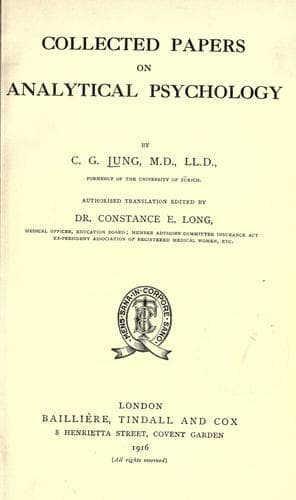
Collected Papers on Analytical PsychologyJung, C. G. (Carl Gustav)
Science
Collected Papers on Analytical Psychology
Jung, C. G. (Carl Gustav)
Psychoanalysis
Later on the sister married, relatively young; the patient did not
marry till twenty-four. She never cared for young men, they all seemed
insipid; her mind turned always to more mature men. When about twenty
she became acquainted with a stately gentleman rather over forty, to
whom she was much drawn. For various reasons the friendship was broken
off. At twenty-four she became acquainted with a widower who had two
children. He was a fine, stately, somewhat corpulent man, and had an
imposing presence, like her father; he was forty-four. She married him
and respected him enormously. The marriage was childless; the children
by the first marriage died from an infectious disease. After four years
of married life her husband also died. For eighteen years she remained
his faithful widow. But at forty-six (just before the menopause) she
experienced a great need of love. As she had no acquaintances she went
to a matrimonial agency and married the first comer, a peasant of some
sixty years who had been already twice divorced on account of brutality
and perverseness; the patient knew this before marriage. She remained
five unbearable years with him, when she also obtained a divorce. The
neurosis set in a little later.
No further discussion will be required for those with psychoanalytic
experience; the case is too obvious. For those unversed in
psychoanalysis let me point out that up to her forty-sixth year the
patient did but reproduce most faithfully the milieu of her earliest
youth. The sexuality which announced itself so late and so drastically,
even here only led to a deteriorated edition of the father-surrogate;
to this she is brought by this late-blossoming sexuality. Despite
repression, the neurosis betrays the ever-fluctuating eroticism of
the aging woman who still wants to please (affectation) but dares not
acknowledge her sexuality.
_Case 2._--A man of thirty-four of small build and with a sensible,
kindly expression. He is easily embarrassed, blushes often. He came for
treatment on account of "nervousness." He says he is very irritable,
readily fatigued, has nervous indigestion, is often deeply depressed so
that he has thought of suicide.
Before coming to me for treatment he sent me a circumstantial
autobiography, or rather a history of his illness, in order to prepare
me for his visit. His story began: "My father was a very big and strong
man." This sentence awakened my curiosity; I turned over a page and
there read: "When I was fifteen a big lad of nineteen took me into the
wood and indecently assaulted me."
The numerous gaps in the patient's story induced me to obtain a more
exact anamnesis from him, which produced the following remarkable facts.
Public-domain text, read in full here on John Shaqi.
Reviews
Reviews
No reviews yet
Be the first to share your thoughts on this work.
Elsewhere in the archive
Join the Discussion
Join the discussion
Sign in to leave a comment or review.
Sign InorCreate an account