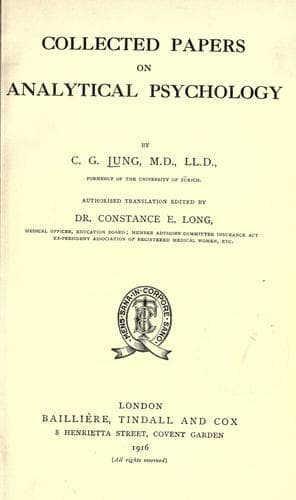
Collected Papers on Analytical PsychologyJung, C. G. (Carl Gustav)
Science
Collected Papers on Analytical Psychology
Jung, C. G. (Carl Gustav)
Psychoanalysis
The patient is the youngest of three brothers. His father, a big,
red-haired man, was formerly a soldier in the Papal Swiss Guard, and
then became a policeman. He was a strict, gruff old soldier, who brought
up his sons with military precision; he commanded them, did not call
them by name, but whistled to them. He had spent his youth in Rome,
where he acquired syphilis, from the consequences of which he still
suffered in old age. He was fond of talking about his adventures in
early life. His eldest son (considerably older than the patient) was
exactly like him, he was big, strong and had reddish hair. The mother
was a feeble woman, prematurely aged; exhausted and tired of life, she
died at forty when the patient was eight years old. He preserved a
tender and beautiful memory of his mother.
When he went to school he was always the whipping-boy and always the
object of his schoolfellows' mockery. The patient considers that his
peculiar dialect was to blame for this. Later he was apprenticed to a
severe and unkind master, under most trying conditions, from which all
the other apprentices had run away, finding them intolerable. Here he
held out for over two years. At fifteen the assault already mentioned
took place, in addition to some other slighter homosexual experiences.
Then fate sent him to France. There he made the acquaintance of a man
from the South of France, a great boaster and Don Juan. He dragged
the patient into a brothel; he went unwilling and out of fear. He
was impotent there. Later he went to Paris, where his brother, a
master-mason, the replica of his father, was leading a dissolute
life. There the patient remained a long time, badly paid and helping
his sister-in-law out of pity. The brother often took him along to a
brothel, where the patient was always impotent. Here the brother asked
him to make over to him his inheritance, 6000 francs. He first consulted
his second brother, who was also in Paris, who urgently tried to
dissuade him from giving the money to his brother, because it would only
be squandered. Nevertheless the patient gave his all to his brother,
who indeed soon squandered it. And the second brother, who would have
dissuaded him, was also let in for 500 francs. To my astonished question
why he had so light-heartedly given the money to his brother without
any guarantee, he replied: he had asked for it, he was not a bit sorry
about the money; he would give him another 6000 francs if he had it. The
eldest brother came to grief altogether and his wife divorced him. The
patient returned to Switzerland and remained for a year without regular
employment, often suffering from hunger. During this time he made the
acquaintance of a family where he became a frequent visitor. The husband
belonged to some peculiar sect; he was a hypocrite and neglected his
family. The wife was elderly, ill and weak, and moreover pregnant.
There were six children and great poverty. The patient developed warm
Public-domain text, read in full here on John Shaqi.
Reviews
Reviews
No reviews yet
Be the first to share your thoughts on this work.
Elsewhere in the archive
Join the Discussion
Join the discussion
Sign in to leave a comment or review.
Sign InorCreate an account