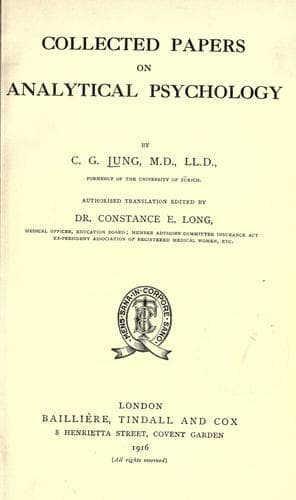
Collected Papers on Analytical PsychologyJung, C. G. (Carl Gustav)
Science
Collected Papers on Analytical Psychology
Jung, C. G. (Carl Gustav)
Psychoanalysis
affection for this woman and divided with her the little he possessed.
She brought him her troubles, and said she felt sure she would die in
childbed. Then he promised her (he who possessed nothing) to take charge
of the children himself and bring them up. The wife did die in childbed.
The orphanage-board interfered, however, and allowed him only one child.
So he had a child but no family, and naturally could not bring it up by
himself. He thus came to think of marrying. But as he had never been
in love with any woman he was in great perplexity. It then occurred to
him that his elder brother was divorced from his wife, and he resolved
to marry her. He wrote his intention to her in Paris. She was seventeen
years older than he, but not disinclined to the plan. She invited him
to come to Paris to talk matters over. On the eve of this journey fate,
however, willed that he should run a big iron nail into his foot so that
he could not travel. After a little while, when the wound was healed,
he went to Paris, and found that he had imagined his sister-in-law, and
now his _fiancée_, to be younger and prettier than she really was. The
wedding took place, and three months later the first coitus, at his
wife's initiative. He himself had no desire for it. They brought up the
child together, he in the Swiss and she in the French way, for she was
a French woman. At the age of nine the child was run over and killed
by a cyclist. The patient then felt very lonely and dismal at home. He
proposed to his wife that she should adopt a young girl, whereupon she
broke out into a fury of jealousy. Then for the first time he fell in
love with a young girl, whilst at the same time the neurosis started,
with deep depression and nervous exhaustion, for meanwhile his life at
home had become a hell.
My proposition to separate from his wife was refused out of hand,
because he could not take upon himself to make the old woman unhappy on
his account. He clearly prefers to be tormented still further; for it
would seem that the recollection of his youth is more precious to him
than any present joys.
In this case also the whole movement of a life takes place in the magic
circle of the familial constellation. The relation to the father is the
strongest and most momentous issue; its masochistic homosexual colouring
stands out clearly everywhere. Even the unhappy marriage is determined
in every way through the father, for the patient marries the divorced
wife of his eldest brother, which _is as if_ he married his mother. His
wife is also the representative of the mother-surrogate, of the friend
who died in childbed.
Public-domain text, read in full here on John Shaqi.
Reviews
Reviews
No reviews yet
Be the first to share your thoughts on this work.
Elsewhere in the archive
Join the Discussion
Join the discussion
Sign in to leave a comment or review.
Sign InorCreate an account