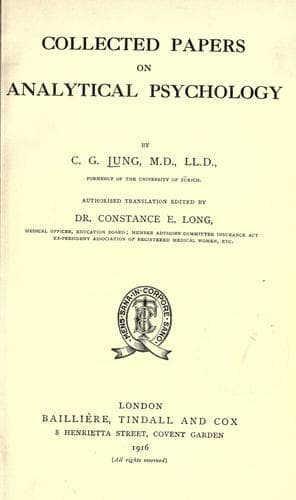
Collected Papers on Analytical PsychologyJung, C. G. (Carl Gustav)
Science
Collected Papers on Analytical Psychology
Jung, C. G. (Carl Gustav)
Psychoanalysis
Only the prophets succeeded in freeing themselves from this constraint;
in them the identification with Jehovah, the complete sublimation,
is successful. They became the fathers of the people. Christ, the
fulfilment of prophecy, put an end to this fear of God and taught
mankind that the true relation to the Godhead is "love." Thus he
destroyed the ceremonial constraint of the Law and gave the example of
a personal loving relationship to God. The later imperfect sublimation
of the Christian Mass leads again to the ceremonial of the Church from
which occasionally the minds capable of sublimation among the saints and
reformers have been able to free themselves. Not without cause therefore
does modern theology speak of "inner" or "personal" experiences as
having great enfranchising power, for always the ardour of love
transmutes the dread and constraint into a higher, freer type of feeling.
What we see in the development of the world-process, the original
source of the changes in the Godhead, we see also in the individual.
Parental power guides the child like a higher controlling fate. But
when he begins to grow up, there begins also the conflict between the
infantile constellation and the individuality, the parental influence
dating from the prehistoric (infantile) period is repressed, sinks into
the unconscious but is not thereby eliminated; by invisible threads it
directs the individual creations of the ripening mind as they appear.
Like everything that has passed into the unconscious, the infantile
constellation sends up into consciousness dim, foreboding feelings,
feelings of mysterious guidance and opposing influences. Here are the
roots of the first religious sublimations. In the place of the father,
with his constellating virtues and faults, there appears, on the one
hand, an altogether sublime deity, on the other the devil, in modern
times for the most part largely whittled away by the perception of one's
own moral responsibility. Elevated love is attributed to the former,
a lower sexuality to the latter. As soon as we approach the territory
of the neurosis, the antithesis is stretched to the utmost limit. God
becomes the symbol of the most complete sexual repression, the Devil the
symbol of sexual lust. Thus it is that the conscious expression of the
father-constellation, like every expression of an unconscious complex
when it appears in consciousness, gets its Janus-face, its positive and
its negative components. A curious, beautiful example of this crafty
play of the unconscious is seen in the love-episode in the Book of
Tobias. Sarah, the daughter of Raguel in Ecbatana, desires to marry; but
her evil fate wills it that seven times, one after another, she chooses
a husband who dies on the marriage-night. The evil spirit Asmodi, by
whom she is persecuted, kills these husbands. She prays to Jehovah to
let her die rather than suffer this shame again. She is despised even by
her father's maid-servants.
Public-domain text, read in full here on John Shaqi.
Reviews
Reviews
No reviews yet
Be the first to share your thoughts on this work.
Elsewhere in the archive
Join the Discussion
Join the discussion
Sign in to leave a comment or review.
Sign InorCreate an account