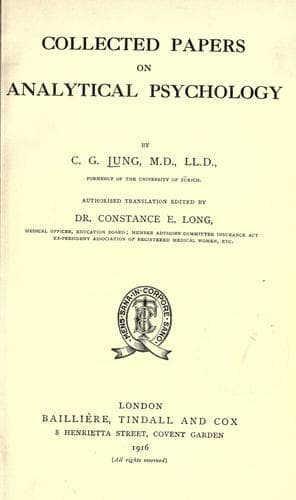
Collected Papers on Analytical PsychologyJung, C. G. (Carl Gustav)
Science
Collected Papers on Analytical Psychology
Jung, C. G. (Carl Gustav)
Psychoanalysis
The eighth bridegroom, Tobias, is sent to
her by God. He too is led into the bridal-chamber. Then the old Raguel,
who has only pretended to go to bed, gets up again and goes out and digs
his son-in-law's grave beforehand, and in the morning sends a maid to
the bridal-chamber to make sure of the expected death. But this time
Asmodi's part is played out, Tobias is alive.
Unfortunately medical etiquette forbids me to give a case of hysteria
which fits in exactly with the above instance, except that there were
not seven husbands, but only three, ominously chosen under all the signs
of the infantile constellation. Our first case too comes under this
category and in our third we see the old peasant at work preparing to
dedicate his daughter to a like fate.
As a pious and obedient daughter (compare her beautiful prayer in
chapter iii.) Sarah has brought about the usual sublimation and cleavage
of the father-complex and on the one side has elevated her childish
love to the adoration of God, on the other has turned the obsessive
force of her father's attraction into the persecuting demon Asmodi.
The legend is so beautifully worked out that it displays the father in
his twofold aspect, on the one hand as the inconsolable father of the
bride, on the other as the secret digger of his son-in-law's grave,
whose fate he foresees. This beautiful fable has become a cherished
paradigm for my analysis, for by no means infrequent are such cases
where the father-demon has laid his hand upon his daughter, so that
her whole life long, even when she does marry, there is never a true
union, because her husband's image never succeeds in obliterating the
unconscious and eternally operative infantile father-ideal. This is
valid not only for daughters, but equally for sons. A fine instance of
such a father-constellation is given in Dr. Brill's recently published:
"Psychological factors in dementia præcox. An analysis."[160]
In my experience the father is usually the decisive and dangerous object
of the child's phantasy, and if ever it happens to be the mother, I have
been able to discover behind her a grandfather to whom she belonged in
her heart.
I must leave this question open: my experience does not go far enough to
warrant a decision. It is to be hoped that the experience of the coming
years will sink deeper shafts into this still dark land which I have
been able but momentarily to light up, and will discover to us more of
the secret workshop of that fate-deciding demon of whom Horace says:
"Scit Genius natale comes qui temperat astrum,
Naturæ deus humanæ, mortalis in unum,
Quodque caput, vultu mutabilis, albus et ater."
FOOTNOTES:
[Footnote 149: _Jahrbuch für Psychoanalytische und Psychopathologische
Forschungen_, vol. I., 1909. Translator, Dr. M. D. Eder.]
[Footnote 150: Freud, especially "The Interpretation of Dreams."]
Public-domain text, read in full here on John Shaqi.
Reviews
Reviews
No reviews yet
Be the first to share your thoughts on this work.
Elsewhere in the archive
Join the Discussion
Join the discussion
Sign in to leave a comment or review.
Sign InorCreate an account