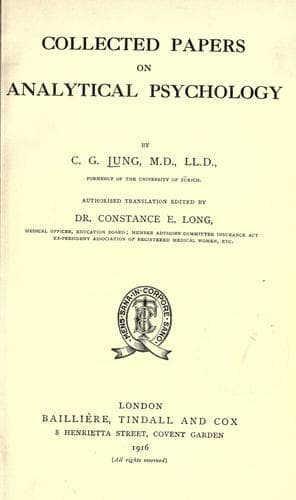
Collected Papers on Analytical PsychologyJung, C. G. (Carl Gustav)
Science
Collected Papers on Analytical Psychology
Jung, C. G. (Carl Gustav)
Psychoanalysis
[Footnote 151: Libido is what earlier psychologists called "will"
or "tendency." The Freudian expression is _denominatio a potiori_.
_Jahrbuch_, vol. I., p. 155, 1909.]
[Footnote 152: Sommer, "Familienforschung und Vererbungslehre." Barth,
Leipzig, 1907. Joerger, "Die Familie, Zero," _Arch. für Rassen u.
Gesellschaftsbiologie_, 1905. M. Ziermer (pseudonym), "Genealogische
Studien über die Vererbung geistiger Eigenschaften," ibid., 1908.]
[Footnote 153: For the importance of the mother, see "The Psychology of
the Unconscious." C. G. Jung. Moffart, Yard and Co., New York.]
[Footnote 154: E. Fürst, "Statistische Untersuchungen über
Wortassoziationen und über familiäre Übereinstimmung im Reaktionstypus
bei Ungebildeten. Beitrag der diagnostischen Assoziationsstudien
herausgegeben von Dr. C. G. Jung," _Journal für Psychologie und
Neurologie_, Bd. II., 1907. (Reprinted in volume two of the Joint
Reports.)]
[Footnote 155: By this type I understand reactions where the response
to the stimulus-word is a predicate subjectively accentuated instead of
an objective relation, _e.g_., Flower, pleasant; frog, horrible; piano,
terrible; salt, bad; singing, sweet; cooking, useful (see p. 124).]
[Footnote 156: Cf. Vigouroux et Jaqueliers, "La contagion mentale,"
Chapitre VI. Doin, Paris, 1905.]
[Footnote 157: Between whiles we believe ourselves masters of our acts
at any given moment. But when we look back along our life's path and
fix our eyes chiefly upon our unfortunate steps and their consequences,
often we cannot understand how we came to do this and leave that undone,
and it seems as if some power outside ourselves had directed our steps.
Shakespeare says;
"Fate show thy force: ourselves we do not owe;
What is decreed must be, and be this so!"
Schopenhauer, "Ueber die anscheinende Absichtlichkeit im Schicksale des
Einzelnen. Parerga und Paralipomena."]
[Footnote 158: This was seen in the Amsterdam Congress of 1907, where
a prominent French savant assured us that the Freudian theory was but
"une plaisanterie." This gentleman has demonstrably neither read Freud's
latest works nor mine, he knows less about the subject than a little
child. This opinion, so admirably grounded, ended with the applause of a
well-known German professor. One can but bow before such thoroughness.
At the same Congress another well-known German neurologist immortalised
his name with the following intellectual reasoning: "If hysteria on
Freud's conception does indeed rest on repressed affects, then the whole
German army must be hysterical."]
[Footnote 159: Cf. Freud, "Zeitschrift für Religionspsychologie," 1907.]
[Footnote 160: _Journal of Abnormal Psychology_, vol. III., p. 219,
1908.]
CHAPTER IV
A CONTRIBUTION TO THE PSYCHOLOGY OF RUMOUR[161]
Public-domain text, read in full here on John Shaqi.
Reviews
Reviews
No reviews yet
Be the first to share your thoughts on this work.
Elsewhere in the archive
Join the Discussion
Join the discussion
Sign in to leave a comment or review.
Sign InorCreate an account