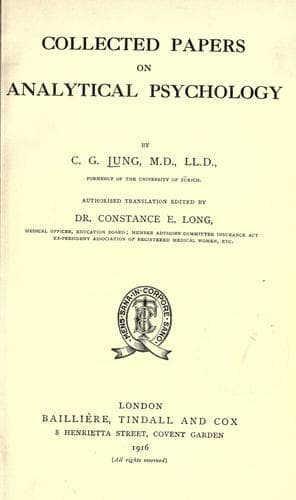
Collected Papers on Analytical PsychologyJung, C. G. (Carl Gustav)
Science
Collected Papers on Analytical Psychology
Jung, C. G. (Carl Gustav)
Psychoanalysis
The symbolism of numbers which greatly engaged the imaginative
philosophy of earlier centuries has again acquired a fresh interest from
the analytic investigations of Freud and his school. But in the material
of number-dreams we no longer discover conscious puzzles of symbolic
concatenations of numbers but the unconscious roots of the symbolism of
numbers. There is scarcely anything quite fundamentally new to offer
in this sphere since the presentations of Freud, Adler and Stekel. It
must here suffice to corroborate their experiences by recording parallel
cases. I have had under observation a few cases of this kind which are
worth reporting for their general interest.
The first three instances are from a middle-aged married man whose
conflict of the moment was an extra-conjugal love affair. The piece
of the dream from which I take the symbolised number is: _in front of
the manager his general subscription. The manager comments on the high
number of the subscription. It reads 2477._
The analysis of the dream brings out a rather ungentlemanly reckoning up
of the expense of the affair, which is foreign to the generous nature
of the dreamer, and which the unconscious makes use of as a resistance
to this affair. The preliminary interpretation is, therefore, that the
number has some financial importance and origin. A rough estimate of the
expenses so far leads to a number which in fact approaches 2477 francs;
a more exact reckoning, however, gives 2387 francs, which could be only
arbitrarily translated into 2477. I then left the numbers to the free
association of the patient; it occurs to him that the figure in the
dream should be divided as 24-77. Perhaps it is a telephone number; this
supposition proves incorrect. The next association is that it is the
total of some numbers. A reminiscence then occurs to him that he once
told me that he had celebrated the 100th birthday of his mother and
himself when his mother was 65 and he was 35 years old. (Their birthdays
are on the same day.)
In this way the patient arrived at the following series of
associations:--
He is born on 26 II.
His mistress 28 VIII.
His wife 1 III.
His mother (his father is long dead) 26 II.
His two children 29 IV.
and 13 VII.
The patient is born II. 75.
His mistress VIII. 85.
He is now 36 years old, his mistress 25.
If this series of associations is written in the usual figures, the
following addition is arrived at:--
26. II. = 262
28. VIII. = 288
1. III. = 13
26. II. = 262
29. IV. = 294
13. VII. = 137
II. 75. = 275
VIII. 85 = 885
25 = 25
36 = 36
----
2477
Public-domain text, read in full here on John Shaqi.
Reviews
Reviews
No reviews yet
Be the first to share your thoughts on this work.
Elsewhere in the archive
Join the Discussion
Join the discussion
Sign in to leave a comment or review.
Sign InorCreate an account