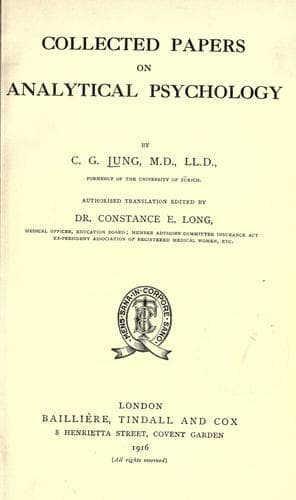
Collected Papers on Analytical PsychologyJung, C. G. (Carl Gustav)
Science
Collected Papers on Analytical Psychology
Jung, C. G. (Carl Gustav)
Psychoanalysis
It is difficult to say where the borderline of play begins; necessarily
so, for the unconscious product is the creation of a sportive fancy, of
that psychic impulse out of which play itself arises. It is repugnant
to the scientific mind to have serious dealings with this element of
play, which on all sides loses itself in the vague. But it must be never
forgotten that the human mind has for thousands of years amused itself
with just this kind of game; it were therefore nothing wonderful if this
historic past again compelled admission in dream to similar tendencies.
The patient pursues in his waking life similar phantastic tendencies
about figures, as is seen in the fact already mentioned of the
celebration of the 100th birthday. Their presence in the dream therefore
need not surprise us. In a single example of unconscious determination
exact proofs are often lacking, but the sum of our experiences entitles
us to rely upon the accuracy of the individual discoveries. In the
investigation of free creative phantasy we are in the region, almost
more than anywhere else, of broad empiricism; a high measure of
discretion as to the accuracy of individual results is consequently
required, but this in nowise obliges us to pass over in silence what is
active and living, for fear of being execrated as unscientific. There
must be no parleying with the superstition-phobia of the modern mind;
for this itself is a means by which the secrets of the unconscious are
kept veiled.
It is of special interest to see how the problems of the patient are
mirrored in the unconscious of his wife. His wife had the following
dream: She dreamt, and this is the whole dream: "_Luke_ 137." The
analysis of the number gives the following. To 1 she associates: The
doctor has another child. He had three. If all her children were living
she would have 7; now she has only 3 - 1 = 2. But she desires 1 + 3 +
7 = 11 (a twin number, 1 and 1), which expresses her wish that her two
children had been pairs of twins, for then she would have reached the
same number of children as the doctor. Her mother once had twins. The
hope of getting a child by her husband is very precarious; this had
for a long time turned her ideas in the unconscious towards a second
marriage. Other phantasies pictured her as "done with," _i.e._ having
reached the climacteric at 44. She is now 33 years old, therefore in
11 years she will have reached her 44th year. This is an important
period as her father died in his 44th year. Her phantasy of the 44th
year contains the idea of the death of her father. The emphasis on the
death of her father corresponds to the repressed phantasy of the death
of her husband, who is the obstacle to a second marriage. At this place
the material belonging to the dream "_Luke_ 137" comes in to solve the
conflict. The dreamer is, one soon discovers, in no wise well up in her
Bible, she has not read it for an incredible time, she is not at all
religious.
Public-domain text, read in full here on John Shaqi.
Reviews
Reviews
No reviews yet
Be the first to share your thoughts on this work.
Elsewhere in the archive
Join the Discussion
Join the discussion
Sign in to leave a comment or review.
Sign InorCreate an account