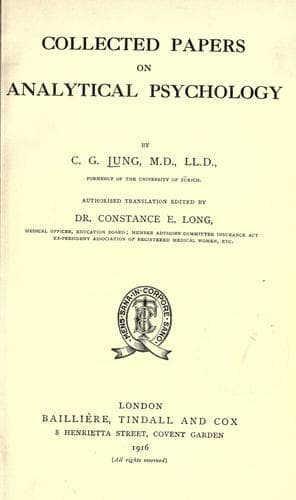
Collected Papers on Analytical PsychologyJung, C. G. (Carl Gustav)
Science
Collected Papers on Analytical Psychology
Jung, C. G. (Carl Gustav)
Psychoanalysis
It would be therefore quite purposeless to have recourse to
associations here. The dreamer's ignorance of her Bible is so great that
she did not even know that the citation "_Luke_ 137" could only refer to
the Gospel of St. Luke. When she turned up the New Testament she came
to the Acts of the Apostles. As chapter i. has only 26 verses and not
37, she took the 7th verse, "It is not for you to know the times or the
seasons, which the Father hath put in his own power."
But if we turn to Luke i. 37, we find the Annunciation of the Virgin.
Verse 35. The Holy Ghost shall come upon thee, and the power of the
Highest shall overshadow thee: therefore also that holy thing which
shall be born of thee shall be called the Son of God.
Verse 36. And, behold, thy cousin Elisabeth, she hath also conceived a
son in her old age: and this is the sixth month with her, who was called
barren.
Verse 37. For with God nothing shall be impossible.
The necessary continuation of the analysis of "_Luke_ 137" demanded the
looking up of Luke xiii. 7, where it says:
Verse 6. A certain man had a fig tree planted in his vineyard; and he
came and sought fruit thereon, and found none.
Verse 7. Then said he unto the dresser of his vineyard, Behold, these
three years I come seeking fruit on this fig tree, and find none: cut it
down; why cumbereth it the ground?
The fig-tree, which from antiquity has been a symbol of the male
genital, is to be cut down on account of its unfruitfulness. This
passage is in complete accord with innumerable sadistic phantasies of
the dreamer, concerned with the cutting or biting off of the penis.
The relation to her husband's unfruitful organ is obvious. That she
withdraws her libido from her husband is clear for he is impotent as
regard herself; it is equally clear that she undergoes regression to the
father ("which the father hath put in his own power") and identifies
herself with her mother who had twins.[166] By thus advancing her age
the dreamer places her husband in regard to herself in the position of
a son or boy, of an age at which impotency is normal. Furthermore, the
desire to overcome her husband is easily understood from, and amply
evidenced in her earlier analysis. It is therefore only a confirmation
of what has been already said, if, following up the matter of "_Luke_
137," we find in Luke vii. verse 12, Now when he came nigh to the gate
of the city, behold, there was a dead man carried out, the only son of
his mother, and she was a widow. (13) And when the Lord saw her, he had
compassion on her, and said unto her, Weep not. (14) And he came and
touched the bier: and they that bare him stood still. And he said, Young
man, I say unto thee, Arise.
Public-domain text, read in full here on John Shaqi.
Reviews
Reviews
No reviews yet
Be the first to share your thoughts on this work.
Elsewhere in the archive
Join the Discussion
Join the discussion
Sign in to leave a comment or review.
Sign InorCreate an account