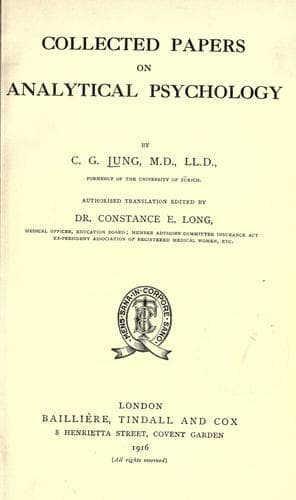
Collected Papers on Analytical PsychologyJung, C. G. (Carl Gustav)
Science
Collected Papers on Analytical Psychology
Jung, C. G. (Carl Gustav)
Psychoanalysis
3. "_The schizophrenic splitting_ of the psyche prevents any final
summing up of the conflicting and corresponding psychisms, so that the
unsuitable impulse can be realised just as much as the right one, and
the negative thought substituted for the right one." "On this theory,
negative manifestations may directly arise, since non-selected positive
and negative psychisms may stand for one another," and so on.
If we investigate psychoanalytically a case of obvious ambivalency,
_i.e._ of a more or less unexpected negative reaction instead of a
positive one, we find that there is a strict sequence of psychological
causes conditioning negative reaction. The tendency of this sequence is
to disturb the intention of the contrasting or opposite series, that is
to say, _it is resistance set up by a complex_. This fact, which has not
yet been refuted by any other observations, seems to me to contradict
the above-mentioned formulæ. (For confirmation, see my "Psychology
of Dementia Præcox," p. 103.) Psychoanalysis has proved conclusively
that a resistance always has an intention and a meaning; that there is
no such thing as a capricious playing with contrasts. The systematic
character of resistance holds good, as I believe I have proved, even in
schizophrenia. So long as this position, founded upon a great variety
of experience, is not disproved by any other observations, the theory
of negativism must adapt itself to it. Bleuler in a sense supports this
when he says: "For the most part the negative reaction does not simply
appear as accidental, _but is actually preferred to the right one_."
This is an admission that negativism is of the nature of resistance.
Once admit this, and the primary importance of ambivalency disappears
so far as negativism is concerned. The tendency to resistance remains
as the only fundamental principle. Ambivalency can in no sense be put
on all fours with the "schizophrenic splitting of the psyche," but must
be regarded as a concept which gives expression to the universal and
ever-present inner association of pairs of opposites. (One of the most
remarkable examples of this is the "contrary meaning of root-words."
See Freud's "Essay on Dreams," Jahrbuch, vol. II., p. 179.) The same
thing applies to ambitendency. Neither is specific of schizophrenia, but
applies equally to the neuroses and the normal. All that is specific to
katatonic negativism is _the intentional contrast, i.e. the resistance_.
From this explanation we see that resistance is something different
from ambivalency; it is the dynamic factor which makes manifest the
everywhere latent ambivalency. What is characteristic of the diseased
mind is not ambivalency but resistance. This implies the existence
of a conflict between two opposite tendencies which has succeeded in
raising the normally present ambivalency into a struggle of opposing
components. (Freud has very aptly called this, "The separation of pairs
Public-domain text, read in full here on John Shaqi.
Reviews
Reviews
No reviews yet
Be the first to share your thoughts on this work.
Elsewhere in the archive
Join the Discussion
Join the discussion
Sign in to leave a comment or review.
Sign InorCreate an account