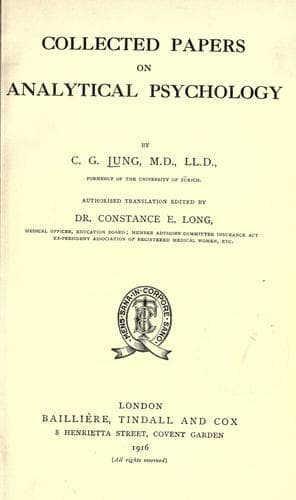
Collected Papers on Analytical PsychologyJung, C. G. (Carl Gustav)
Science
Collected Papers on Analytical Psychology
Jung, C. G. (Carl Gustav)
Psychoanalysis
of opposites.") In other words it is a conflict of wills, bringing about
the neurotic condition of "disharmony within the self." This condition
is the only "splitting of the psyche" known to us, and is not so much
to be regarded as a predisposing cause, but rather as a manifestation
resulting from the inner conflict--the "incompatibility of the complex"
(Riklin).
_Resistance_, as the fundamental fact of schizophrenic dissociation,
thus becomes something which, in contra-distinction to ambivalency, is
not _eo ipso_ identical with the concept of the state of feeling, but
is a secondary and supplementary one, with its own special and _quasi_
independent psychological development; and this is identical with the
necessary previous history of the complex in every case. It follows that
the theory of negativism coincides with the theory of the complex, as
the complex is the cause of the resistance.
Bleuler summarises the causes of negativism as follows:
(_a_) The autistic retirement of the patient into his own
phantasies.
(_b_) The existence of a life-wound (complex) which must be
protected from injury.
(_c_) The misconception of the environment and of its meaning.
(_d_) The directly hostile relation to environment.
(_e_) The pathological irritability of schizophrenics.
(_f_) The "press of ideas," and other aggravations of action and
thought.
(_g_) Sexuality with its ambivalency on the emotional plane is
often one of the roots of negative reaction.
* * * * *
(_a_) Autistic withdrawal into one's own phantasies[170] is what I
formerly designated as the obvious overgrowth of the phantasies of
the complex. The strengthening of the complex is coincident with the
increase of the resistance.
(_b_) The life-wound (_Lebenswund_) is the complex which, as a matter
of course, is present in every case of schizophrenia, and of necessity
always carries with it the phenomena of autism or auto-erotism
(introversion), for complexes and involuntary egocentricity are
inseparable reciprocities. Points (_a_) and (_b_) are therefore
identical. (_Cf._ "Psychology of Dementia Præcox," chapters ii. and iii.)
(_c_) It is proved that the misconception of environment is an
assimilation of the complex.
(_d_) The hostile relation to environment is the maximum of resistance
as psychoanalysis clearly shows. (_d_) goes with (_a_).
(_e_) "Irritability" proves itself psychoanalytically to be one of the
commonest results of the complex. I designated it _complex-sensibility_.
Its generalised form (if one may use such an expression) manifests
itself as a damming up of the affect (= damming of the _libido_),
consequent on increased resistance. So-called neurasthenia is a
classical example of this.
Public-domain text, read in full here on John Shaqi.
Reviews
Reviews
No reviews yet
Be the first to share your thoughts on this work.
Elsewhere in the archive
Join the Discussion
Join the discussion
Sign in to leave a comment or review.
Sign InorCreate an account