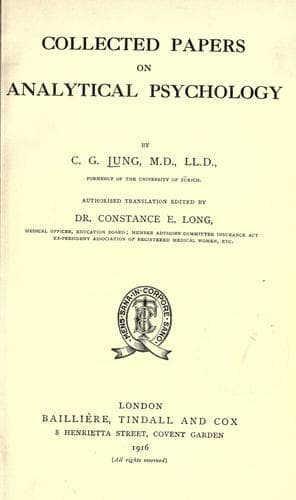
Collected Papers on Analytical PsychologyJung, C. G. (Carl Gustav)
Science
Collected Papers on Analytical Psychology
Jung, C. G. (Carl Gustav)
Psychoanalysis
Psychologists and doctors in general are by no means conversant
with this particular branch of psychology, owing to the fact that
its technical foundations are as yet comparatively unknown to them.
Reason for this may be found in that the new method is exquisitely
psychological, and therefore belongs neither to the realm of medicine
nor to that of experimental psychology. The medical man has, as a rule,
but little knowledge of psychology; and the psychologist has no medical
knowledge. There is therefore a lack of suitable soil in which to plant
the spirit of this new method. Furthermore, the method itself appears
to many persons so arbitrary that they cannot reconcile it with their
scientific conscience. The conceptions of Freud, the founder of this
method, laid particular stress upon the sexual factor; this fact has
aroused strong prejudice, and many scientific men are repelled merely
by this feeling. I need hardly remark that such an antipathy is not a
logical ground for rejecting a new method. The facts being so, it is
obvious that the psychoanalyst should discuss the principles rather than
the results of his method, when he speaks in public; for he who does not
acknowledge the scientific character of the method cannot acknowledge
the scientific character of its results.
Before I enter into the principles of the psychoanalytic method, I must
mention two common prejudices against it.
The first of these is that psychoanalysis is nothing but a somewhat
deep and complicated form of anamnesis. Now it is well known that the
anamnesis is based upon the evidence supplied by the patient's family,
and upon his own conscious self-knowledge, revealed in reply to direct
questions. The psychoanalyst naturally develops his anamnesic data as
carefully as any other specialist; but this is merely the patient's
history, and must not be confused with analysis. Analysis is the
reduction of an actual conscious content of a so-called accidental
nature, into its psychological determinants. This process has nothing to
do with the anamnesic reconstruction of the history of the illness.
Public-domain text, read in full here on John Shaqi.
Reviews
Reviews
No reviews yet
Be the first to share your thoughts on this work.
Elsewhere in the archive
Join the Discussion
Join the discussion
Sign in to leave a comment or review.
Sign InorCreate an account