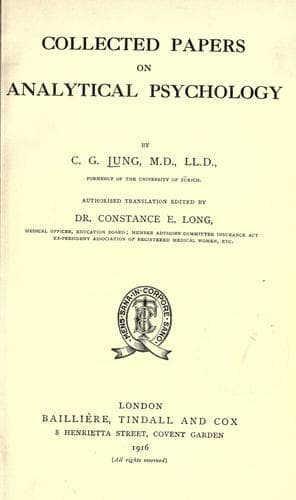
Collected Papers on Analytical PsychologyJung, C. G. (Carl Gustav)
Science
Collected Papers on Analytical Psychology
Jung, C. G. (Carl Gustav)
Psychoanalysis
The second prejudice, which is based, as a rule, upon a superficial
knowledge of psychoanalytic literature, is that psychoanalysis is
a method of suggestion, by which a faith or doctrine of living is
imposed upon the patient, thereby effecting a cure in the manner of
mental healing or Christian Science. Many analysts, especially those
who have worked in psychoanalysis for a long time, previously used
therapeutic suggestion, and are therefore familiar with its workings.
They know that the psychoanalyst's method of working is diametrically
opposed to that of the hypnotist. In direct contrast with therapeutic
suggestion, the psychoanalyst does not attempt to force anything upon
his patient which the latter does not see himself, and find reasonable
with his own understanding. Faced with the constant desire on the
part of the neurotic patient to receive suggestions and advice, the
analyst just as constantly endeavours to lead him away from this
passive receptive attitude, and make him use his common sense and
powers of criticism, that equipped with these he may become fitted to
meet the problems of life independently. We have often been accused
of forcing interpretations upon patients, interpretations that were
frequently quite arbitrary in character. I wish that one of these
critics would make the attempt to force such arbitrary interpretations
upon my patients, who are often persons of great intelligence and high
culture, and who are, indeed, not infrequently my own colleagues. The
impossibility of such an undertaking would soon be laid bare. In
psychoanalysis we are dependent upon the patient and his judgment, for
the reason that the very nature of analysis consists in leading him to
a knowledge of his own self. The principles of psychoanalysis are so
entirely different from those of therapeutic suggestion that they are
not comparable.
An attempt has also been made to compare analysis with the reasoning
method of Dubois, which is in itself a rational process. This comparison
does not however hold good, for the psychoanalyst strictly avoids
argument and persuasion with his patients. He must naturally listen to
and take note of the conscious problems and conflicts of his patient,
but not for the purpose of fulfilling his desire to obtain advice or
direction with regard to his conduct. The problems of a neurotic patient
cannot be solved by advice and conscious argument. I do not doubt
that good advice at the right time can produce good results; but I do
not know whence one can obtain the belief that the psychoanalyst can
always give the right advice at the right time. The neurotic conflict
is frequently, indeed as a rule, of such a character that advice cannot
possibly be given. Furthermore, it is well known that the patient only
desires authoritative advice in order that he may cast aside the burden
of responsibility, referring himself and others to the opinion of the
higher authority.
Public-domain text, read in full here on John Shaqi.
Reviews
Reviews
No reviews yet
Be the first to share your thoughts on this work.
Elsewhere in the archive
Join the Discussion
Join the discussion
Sign in to leave a comment or review.
Sign InorCreate an account