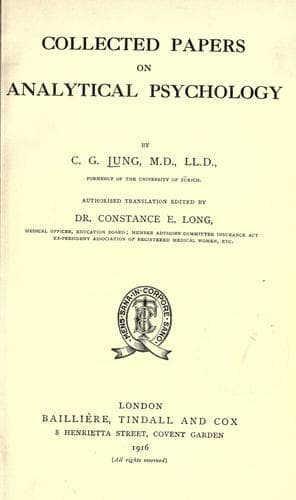
Collected Papers on Analytical PsychologyJung, C. G. (Carl Gustav)
Science
Collected Papers on Analytical Psychology
Jung, C. G. (Carl Gustav)
Psychoanalysis
Let us take another case. A woman of 40, the mother of four children,
became neurotic four years ago after the death of one of her children.
A new period of pregnancy, followed by the birth of another child,
produced a great improvement in her condition. The patient now lived
in the thought that it would be a great help to her if she could have
yet another child. Believing, however, that this could not happen, she
attempted to devote her energies to philanthropic interests. But she
failed to obtain the least satisfaction from this work. She observed a
distinct alleviation of her complaint whenever she succeeded in giving
real, living interest to any matter, but she felt entirely incapable
of discovering anything that could bring her lasting interest and
satisfaction. It is clear that no process of reasoning can solve this
problem.
Here psychoanalysis must begin with the endeavour to solve the problem
as to what prevents the patient from developing interests above and
beyond her longing for a child.
Since we cannot assume that we know from the very beginning what the
solution of such problems is, we must at this point trust to the clues
furnished us by the individuality of the patient. Neither conscious
questioning nor rational advice can aid us in the discovery of these
clues, for the causes which prevent us from finding them are hidden
from her consciousness. There is, therefore, no clearly indicated path
by which to reach these subconscious inhibitions. The only rule that
psychoanalysis lays down for our guidance in this respect, is to let the
patient speak of that which occurs to him at the moment. The analyst
must observe carefully what the patient says and, in the first instance,
take due note thereof without attempting to force his own opinions upon
him. Thus we observe that the patient whom I first mentioned begins by
talking about his marriage, which we hitherto had reason to regard as
normal. We now learn that he constantly has difficulties with his wife,
and that he does not understand her in the least. This knowledge causes
the physician to remark that the patient's professional work is clearly
not his only problem; but that his conjugal relations are also in need
of revision. This starts a train of thought in which many further ideas
occur to the patient, concerning his married life. Hereupon follow ideas
about the love affairs he had before his marriage. These experiences,
related in detail, show that the patient was always somewhat peculiar
in his more intimate relations with women, and that this peculiarity
took the form of a certain childish egoism. This is a new and surprising
point of view for him, and explains to him many of his misfortunes with
women.
Public-domain text, read in full here on John Shaqi.
Reviews
Reviews
No reviews yet
Be the first to share your thoughts on this work.
Elsewhere in the archive
Join the Discussion
Join the discussion
Sign in to leave a comment or review.
Sign InorCreate an account