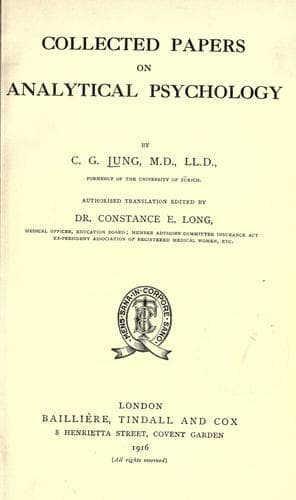
Collected Papers on Analytical PsychologyJung, C. G. (Carl Gustav)
Science
Collected Papers on Analytical Psychology
Jung, C. G. (Carl Gustav)
Psychoanalysis
We cannot in every case get so far as this on the simple principle
of letting the patient talk; few patients have their psychic material
so much on the surface. Furthermore, many persons have a positive
resistance against speaking freely about what occurs to them on the
spur of the moment; it is often too painful to tell the doctor whom
perhaps they do not entirely trust; in other cases because apparently
nothing occurs to them, they force themselves to speak of matters about
which they are more or less indifferent. This habit of not talking to
the point by no means proves that patients consciously conceal their
unpleasant contents, for such irrelevant speaking can occur quite
unconsciously. In such cases it sometimes helps the patient if he is
told that he must not force himself, that he must only seize upon the
very first thoughts that present themselves, no matter how unimportant
or ridiculous they may seem. In certain cases even these instructions
are of no use, and then the doctor is obliged to have recourse to other
expedients. One of these is the employment of the association test,
which usually gives excellent information as to the chief momentary
tendencies of the individual.
A second expedient is dream analysis; this is _the real instrument_ of
psychoanalysis. We have already experienced so much opposition to dream
analysis that a brief exposition of its principles is necessary. The
interpretation of dreams, as well as the meaning given to them, is, as
we know, in bad odour. It is not long since that oneirocritics were
practised and believed in; nor is the time long past when even the most
enlightened human beings were entirely under the ban of superstition.
It is therefore comprehensible that our age should still retain a
certain lively fear of those superstitions which have but recently been
partially overcome. To this timidity in regard to superstition, the
opposition to dream analysis is in a large measure due; but analysis is
in no wise to blame for this. We do not select the dream as our object
because we pay it the homage of superstitious admiration, but because it
is a psychic product that is independent of the patient's consciousness.
We ask for the patient's free thoughts, but he gives us little, or
nothing; or at best something forced or irrelevant. Dreams are free
thoughts, free phantasies, they are not forced, and they are psychic
phenomena just as much as thoughts are.
Public-domain text, read in full here on John Shaqi.
Reviews
Reviews
No reviews yet
Be the first to share your thoughts on this work.
Elsewhere in the archive
Join the Discussion
Join the discussion
Sign in to leave a comment or review.
Sign InorCreate an account