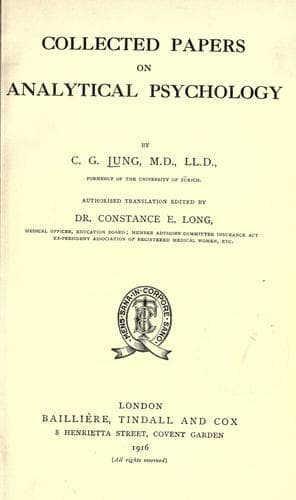
Collected Papers on Analytical PsychologyJung, C. G. (Carl Gustav)
Science
Collected Papers on Analytical Psychology
Jung, C. G. (Carl Gustav)
Psychoanalysis
Sometimes the resistances are of a more serious character. For
instance, persons who cannot admit certain morally grave sides to
their characters, project their deficiencies upon the doctor by calmly
presuming that he is more or less deficient morally, and that for this
reason they cannot communicate certain unpleasant things to him. If,
then a patient does not dream from the beginning or ceases to dream he
retains material which is susceptible of conscious elaboration. Here the
personal relation between the doctor and his patient may be regarded
as the chief hindrance. It can prevent them both, the doctor as well
as the patient, from seeing the situation clearly. We must not forget
that, as the doctor shows, and must show, a searching interest in the
psychology of his patient, so, too, the patient, if he has an active
mind, gains some familiarity with the psychology of the doctor and
assumes a corresponding attitude towards him. Thus the doctor is blind
to the mental attitude of the patient to the exact extent that he does
not see himself and his own subconscious problems. Therefore I maintain
that a doctor must be analysed before he practises analysis. Otherwise
the practice of analysis can easily be a great disappointment to him,
because he can, under certain circumstances, reach a point where further
progress is impossible, a situation which may make him lose his head.
He is then readily inclined to assume that psychoanalysis is nonsense,
so as to avoid the admission that he has run his vessel ashore. If you
are sure of your own psychology you can confidently tell your patient
that he does not dream because there is still conscious material to be
disposed of. I say that one must be sure of one's self in such cases,
for the opinions and unsparing criticisms to which one sometimes has to
submit, can be excessively disturbing to one who is unprepared to meet
them. The immediate consequence of such a loss of personal balance on
the part of the doctor is that he begins to argue with his patient, in
order to maintain his influence over him; and this, of course, renders
all further analysis impossible.
Public-domain text, read in full here on John Shaqi.
Reviews
Reviews
No reviews yet
Be the first to share your thoughts on this work.
Elsewhere in the archive
Join the Discussion
Join the discussion
Sign in to leave a comment or review.
Sign InorCreate an account