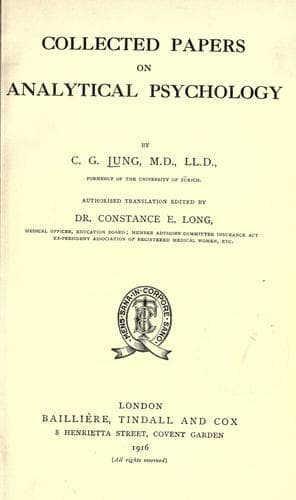
Collected Papers on Analytical PsychologyJung, C. G. (Carl Gustav)
Science
Collected Papers on Analytical Psychology
Jung, C. G. (Carl Gustav)
Psychoanalysis
In this manner we obtain a comparative study of the act of baptism.
Thus we ascertain the elements from which baptism is derived; we
further ascertain its original meaning, and at the same time make the
acquaintance of a world rich in religious mythology, which makes clear
to us all the multifarious and derived meanings of the act of baptism.
Thus the analyst deals with the dream. He gathers together historical
parallels for each dream part, even though they be very remote and
attempts to construct the psychological history of the dream and the
meanings that underlie it. By this monographic elaboration of the
dream one gains, exactly as in the analysis of the act of baptism, a
deep insight into the wonderfully subtle and significant network of
subconscious determinations; an insight which, as I have said, can only
be compared with the historical understanding of an act that we used
only to consider from a very one-sided and superficial point of view.
I cannot disguise the fact that in practice, especially at the beginning
of an analysis, we do not in all cases make complete and ideal analyses
of dreams, but that we more generally continue to gather together the
dream associations until the problem which the patient hides from us
becomes so clear that even he can recognize it. This problem is then
subjected to conscious elaboration until it is cleared up as far as
possible, and once again we stand before a question that cannot be
answered.
You will now ask what course is to be pursued when the patient does not
dream at all; I can assure you that hitherto all patients, even those
who claimed never to have dreamed before, began to dream when they
went through analysis. But on the other hand it frequently occurs that
patients who began by dreaming vividly are suddenly no longer able to
remember their dreams. The empirical and practical rule, which I have
hitherto regarded as binding, is that the patient, if he does not dream,
has sufficient conscious material, which he keeps back for certain
reasons. A common reason is: "I am in the doctor's hands and am quite
willing to be treated by him. But the doctor must do the work, I shall
remain passive in the matter."
Public-domain text, read in full here on John Shaqi.
Reviews
Reviews
No reviews yet
Be the first to share your thoughts on this work.
Elsewhere in the archive
Join the Discussion
Join the discussion
Sign in to leave a comment or review.
Sign InorCreate an account