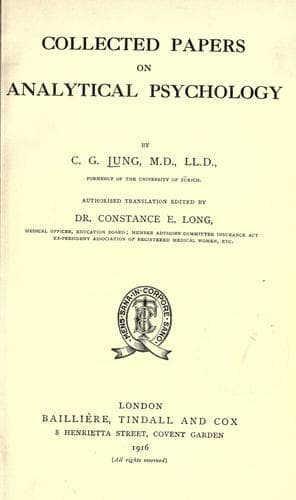
Collected Papers on Analytical PsychologyJung, C. G. (Carl Gustav)
Science
Collected Papers on Analytical Psychology
Jung, C. G. (Carl Gustav)
Psychoanalysis
In the papers appearing for the first time in this edition (Chapters
XIV. and XV.), Dr. Jung develops his ideas of introversion and
extroversion, a contribution of the first importance to psychology.
He agrees with Freud in regarding the neuroses to be the result of
repression, but differs in his view as to the origin of repression.
He finds this to lie not in sexuality _per se_, but rather in man's
natural tendency to adapt to the demands of life one-sidedly, according
to his type of mentality. The born extrovert adapts by means of
feeling, thought being under repression and relatively infantile. The
introvert's natural adaptation is by means of thought; feeling being
more or less repressed remains undeveloped. In either type the neglected
co-function is behind the adapted function. This inequality operating
in the unconscious, brings about a conflict, which in certain subjects
amounts to a neurosis, and in others produces a limitation of individual
development. This view shifts the interpretation of repression on to a
much more comprehensive basis than that of sexuality, although there can
scarcely be a repression that does not include this instinct on account
of its deep and far-reaching importance in man.
There is no doubt that some even scientific persons have a certain
fear of whither the study of the unconscious may lead. These fearful
persons should be reminded that they possess an unconscious in spite of
themselves, and that they share it in common with every human being. It
is an extension of the individual. To study it is to deepen the self.
All new discoveries have at one stage been called dangerous, and all new
philosophies have been deemed heresies. It is as though we would once
more consign radium to its dust-heaps, lest some day the new radiancy
should over-power mankind. Indeed this particular thing has proved
at once most dangerous and most precious. Man must learn to use his
treasure, and in using it to _submit to its own laws_, which can only
become known when it is handled and investigated.
Public-domain text, read in full here on John Shaqi.
Reviews
Reviews
No reviews yet
Be the first to share your thoughts on this work.
Join the Discussion
Join the discussion
Sign in to leave a comment or review.
Sign InorCreate an account