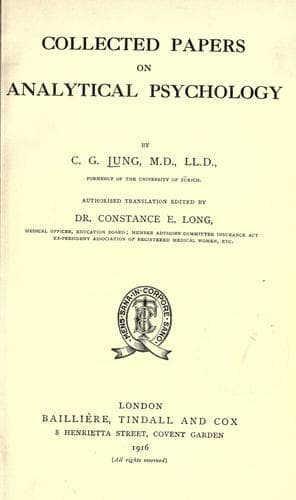
Collected Papers on Analytical PsychologyJung, C. G. (Carl Gustav)
Science
Collected Papers on Analytical Psychology
Jung, C. G. (Carl Gustav)
Psychoanalysis
The above-mentioned formula, according to which the sexuality of a
dream is a symbolic or analogous expression, naturally also holds good
in the case of dreams occurring in the beginning of an analysis. But the
practical reasons that have induced us not to take into consideration
the symbolic value of this sexual phantasy, owe their existence to the
fact that a genuine realistic value must be given to the abnormal sexual
phantasies of a neurotic, in so far as the latter suffers himself to be
influenced in his actions by these phantasies. Experience teaches us
that these phantasies not only hinder him from adapting himself suitably
to his situation, but that they also lead him to all manner of really
sexual acts, and occasionally even to incest. Under these circumstances,
it would be of little use to consider the symbolic content of the dream
only; the concrete content must first be disposed of.
These arguments are based upon a different conception of the dream
from that put forward by Freud; for, indeed, my experience has forced
me to a different conception. According to Freud, the dream is in its
essence a symbolic veil for repressed desires which are in conflict
with the ideals of the personality. I am obliged to regard the dream
structure from a different point of view. The dream for me is, in the
first instance, the subliminal picture of the psychological condition
of the individual in his waking state. It presents a _résumé_ of the
subliminal association material which is brought together by the
momentary psychological situation. The volitional meaning of the
dream which Freud calls the repressed desire, is, for me, essentially
a means of expression. The activity of the consciousness, speaking
biologically, represents the psychological effort which the individual
makes in adapting himself to the conditions of life. His consciousness
endeavours to adjust itself to the necessities of the moment, or, to put
it differently: there are tasks ahead of the individual, which he must
overcome. In many cases the solution is unknown; and for this reason the
consciousness always tries to find the solution by the way of analogous
experience. We always try to grasp what is unknown and in the future,
according to our mental understanding of what has gone before. Now we
have no reasons for assuming that the unconscious follows other laws
than those which apply to conscious thought. The unconscious, like the
conscious, gathers itself about the biological problems and endeavours
to find solutions for these by analogy with what has gone before, just
as much as the conscious does. Whenever we wish to assimilate something
that is unknown, we arrive at it by a process of comparison. A simple
example of this is the well-known fact that, when America was discovered
by the Spaniards, the Indians took the horses of the conquerors, which
were strange to them, for large pigs, because pigs were familiar to
their experience.
Public-domain text, read in full here on John Shaqi.
Reviews
Reviews
No reviews yet
Be the first to share your thoughts on this work.
Elsewhere in the archive
Join the Discussion
Join the discussion
Sign in to leave a comment or review.
Sign InorCreate an account