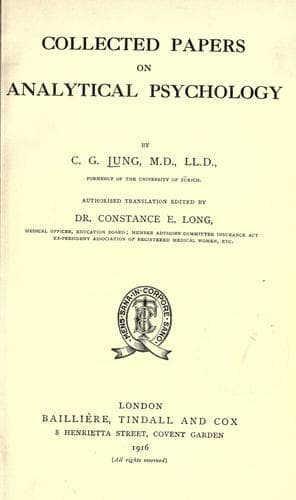
Collected Papers on Analytical PsychologyJung, C. G. (Carl Gustav)
Science
Collected Papers on Analytical Psychology
Jung, C. G. (Carl Gustav)
Psychoanalysis
This is the mental process which we always employ in
recognising unknown things; and this is the essential reason for the
existence of symbolism. It is a process of comprehension by means of
analogy. The apparently repressed desires, contained in the dream, are
volitional tendencies which serve as language-material for subconscious
expression. So far as this particular point is concerned, I am in full
accord with the views of Adler, another member of Freud's school. With
reference to the fact that subconscious materials of expression are
volitional elements or tendencies, I may say that this is dependent
upon the archaic nature of dream thinking, a problem with which I have
already dealt in previous researches.[174]
Owing to our different conception of the structure of the dream, the
further course of analysis also gains a different complexion from
that which it had until now. The symbolic valuation given to sexual
phantasies in the later stages of analysis necessarily leads less to the
reduction of the patient's personality into primitive tendencies, than
to the extension and further development of his mental attitude; that
is, it tends to make his thinking richer and deeper, thus giving him
what has always been one of the most powerful weapons that a human being
can have in his struggle to adapt himself to life. By following this new
course logically, I have come to the conclusion that these religious
and philosophical motive forces--the so-called metaphysical needs of
the human being--must receive positive consideration at the hands of
the analyst. Though he must not destroy the motive forces that underlie
them, by reducing them to their primitive, sexual roots, he must make
them serve biological ends as psychologically valuable factors. Thus
these instincts assume once more those functions that have been theirs
from time immemorial.
Just as primitive man was able, with the aid of religious and
philosophical symbol, to free himself from his original state, so, too,
the neurotic can shake off his illness in a similar way. It is hardly
necessary for me to say, that I do not mean by this, that the belief in
a religious or philosophical dogma should be thrust upon the patient; I
mean simply that he has to reassume that psychological attitude which,
in an earlier civilisation, was characterised by the living belief in
a religious or philosophical dogma. But the religious-philosophical
attitude does not necessarily correspond to the belief in a dogma. A
dogma is a transitory intellectual formulation; it is the result of
the religious-philosophical attitude, and is dependent upon time and
circumstances. This attitude is itself an achievement of civilization;
it is a function that is exceedingly valuable from a biological point
of view, for it gives rise to the incentives that force human beings to
do creative work for the benefit of a future age, and, if necessary, to
sacrifice themselves for the welfare of the species.
Public-domain text, read in full here on John Shaqi.
Reviews
Reviews
No reviews yet
Be the first to share your thoughts on this work.
Elsewhere in the archive
Join the Discussion
Join the discussion
Sign in to leave a comment or review.
Sign InorCreate an account