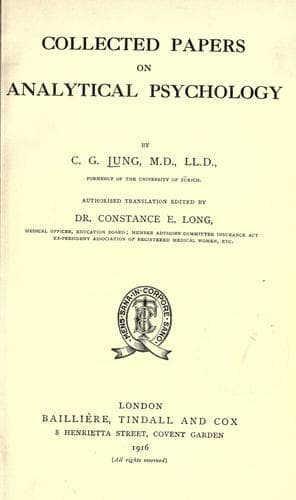
Collected Papers on Analytical PsychologyJung, C. G. (Carl Gustav)
Science
Collected Papers on Analytical Psychology
Jung, C. G. (Carl Gustav)
Psychoanalysis
Thus the human being attains the same sense of unity and totality, the
same confidence, the same capacity for self-sacrifice in his conscious
existence that belongs unconsciously and instinctively to wild animals.
Every reduction, every digression from the course that has been laid
down for the development of civilisation does nothing more than turn
the human being into a crippled animal; it never makes a so-called
natural man of him. My numerous successes and failures in the course of
my analytic practice have convinced me of the invariable correctness of
this psychological orientation. We do not help the neurotic patient by
freeing him from the demand made by civilisation; we can only help him
by inducing him to take an active part in the strenuous task of carrying
on the development of civilisation. The suffering which he undergoes in
performing this duty takes the place of his neurosis. But, whereas the
neurosis and the complaints that accompany it are never followed by the
delicious feeling of good work well done, of duty fearlessly performed,
the suffering that comes from useful work, and from victory over real
difficulties, brings with it those moments of peace and satisfaction
which give the human being the priceless feeling that he has really
lived his life.
FOOTNOTES:
[Footnote 173: Reprinted from the _Transactions of the Psycho-Medical
Society_, August 5th, 1913.]
[Footnote 174: See "Psychology of the Unconscious."]
CHAPTER VIII
ON PSYCHOANALYSIS[175]
After many years' experience I now know that it is extremely difficult
to discuss psychoanalysis at public meetings and at congresses. There
are so many misconceptions of the matter, so many prejudices against
certain psychoanalytic views, that it becomes an almost impossible task
to reach mutual understanding in public discussion. I have always found
a quiet conversation on the subject much more useful and fruitful than
heated discussions _coram publico_. However, having been honoured by
an invitation from the Committee of this Congress as a representative
of the psychoanalytic movement, I will do my best to discuss some of
the fundamental theoretical conceptions of psychoanalysis. I must limit
myself to this part of the subject because I am quite unable to place
before my audience all that psychoanalysis means and strives for, all
its various applications, its psychology, its theoretical tendencies,
its importance for the realm of the so-called "Geisteswissenschaften,"
_e.g._ Mythology, Comparative Religion, Philosophy, &c. But if I am to
discuss certain theoretical problems fundamental to psychoanalysis, I
must presuppose my audience to be well acquainted with the development
and main results of psychoanalytic researches. Unfortunately, it often
happens that people believe themselves entitled to judge psychoanalysis
who have not even read the literature. It is my firm conviction that no
one is competent to form a judgment concerning the subject until he has
Public-domain text, read in full here on John Shaqi.
Reviews
Reviews
No reviews yet
Be the first to share your thoughts on this work.
Elsewhere in the archive
Join the Discussion
Join the discussion
Sign in to leave a comment or review.
Sign InorCreate an account