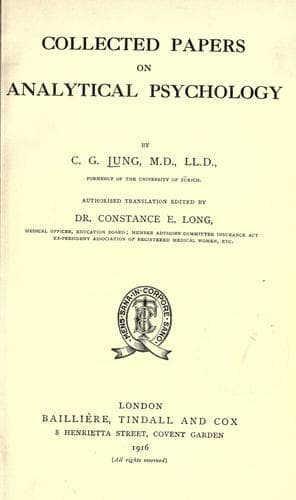
Collected Papers on Analytical PsychologyJung, C. G. (Carl Gustav)
Science
Collected Papers on Analytical Psychology
Jung, C. G. (Carl Gustav)
Psychoanalysis
This is, so far as I can see, the essence of Freud's theory. But this
conception neglects the following important question: What is the cause
of this fixation of the libido to the old infantile phantasies and
habits? We have to remember that almost all persons have at some time
had infantile phantasies and habits exactly corresponding to those
of a neurotic, but they do not become fixed to them; consequently,
they do not become neurotic later on. The ætiological secret of the
neurosis, therefore, does not consist in the mere _existence_ of
infantile phantasies, but lies in the so-called _fixation_. The manifold
statements of the existence of infantile sexual phantasies in neurotic
cases are worthless, in so far as they attribute an ætiological value
to them, for the same phantasies can be found in normal individuals as
well, a fact which I have often proved. It is only the fixation which
seems to be characteristic. It is important to demand the nature of
the proofs of the real existence of this infantile fixation. Freud, an
absolutely sincere and thorough empiricist, would never have evolved
this hypothesis had he not had sufficient grounds for it. The grounds
are found in the results of the psychoanalytic investigations of the
unconscious. Psychoanalysis discloses the unconscious existence of
manifold phantasies, which have their end root in the infantile past
and turn around the so-called "_Kern-complex_," or nucleus-complex,
which may be designated in male individuals as the Œdipus-complex
and in females as the Electra-complex. These terms convey their own
meaning exactly. The whole tragic fate of Œdipus and Electra took place
within the narrow confines of the family, just as the child's fate
lies wholly within the family boundaries. Hence the Œdipus conflict is
very characteristic of an infantile conflict, so also is the Electra
conflict. The existence of these conflicts in infancy is largely
proven by means of psychoanalytic experience. It is in the realm of
this complex that the fixation is supposed to have taken place. Through
the highly potent and effective existence of the nucleus-complex in
the unconscious of neurotics, Freud was led to the hypothesis, that
the neurotic has a peculiar fixation or attachment to it. Not the mere
existence of this complex--for everybody has it in the unconscious--but
the very strong attachment to it is what is typical of the neurotic.
He is far more influenced by this complex than the normal person; many
examples in confirmation of this statement will be found in every one of
the recent psychoanalytic histories of neurotic cases.
Public-domain text, read in full here on John Shaqi.
Reviews
Reviews
No reviews yet
Be the first to share your thoughts on this work.
Elsewhere in the archive
Join the Discussion
Join the discussion
Sign in to leave a comment or review.
Sign InorCreate an account