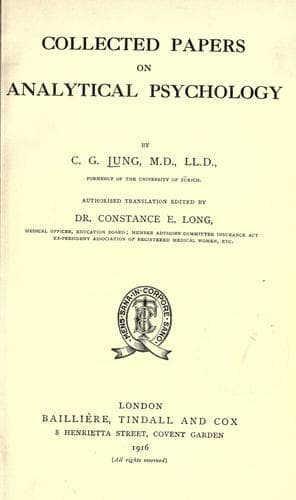
Collected Papers on Analytical PsychologyJung, C. G. (Carl Gustav)
Science
Collected Papers on Analytical Psychology
Jung, C. G. (Carl Gustav)
Psychoanalysis
We must admit that this conception is a very plausible one, because
the hypothesis of fixation is based upon the well-known fact, that
certain periods of human life, and particularly infancy, do sometimes
leave determining traces for ever. The only question is whether this
principle is a sufficient explanation or not. If we examine persons who
have been neurotic from infancy it seems to be confirmed, for we see
the nucleus-complex as a permanent and powerful activity throughout
the whole life. But if we take cases which never show any considerable
traces of neurosis except at the particular time when they break down,
and there are many such, this principle becomes doubtful. If there
is such a thing as fixation, it is not permissible to base upon it a
new hypothesis, claiming that at times during certain epochs of life
the fixation becomes loosened and ineffective, while at others it
suddenly becomes strengthened and effective. In such cases we find the
nucleus-complex as active and as potent as in those which apparently
support the theory of fixation. Here a critical attitude is peculiarly
justifiable, when we consider the often-repeated observation that the
moment of the outbreak of the disease is by no means indifferent; as a
rule it is most critical. It usually occurs _at the moment when a new
psychological adjustment, that is, a new adaptation, is demanded_. Such
moments facilitate the outbreak of a neurosis, as every experienced
neurologist knows. This fact seems to me extremely significant. If
the fixation were indeed real we should expect to find its influence
constant, _i.e._ a neurosis continuous throughout life. This is
obviously not the case. The psychological determination of a neurosis
is only partially due to an early infantile predisposition; it is due
to a certain actual cause as well. And if we carefully examine the kind
of infantile phantasies and events to which the neurotic individual
is attached, we shall be obliged to agree that there is nothing in
them specific for neurosis. Normal individuals have pretty much the
same kind of internal and external experiences, and are attached to
them to an even astonishing degree, without developing a neurosis.
You will find primitive people, especially, very much bound to their
infantility. It now begins to look as if this so-called fixation were
a normal phenomenon, and that the importance of infancy for the later
mental attitude is natural and prevails everywhere. The fact that the
neurotic seems to be markedly influenced by his infantile conflicts,
shows that it is less a matter of fixation than of a peculiar use which
he makes of his infantile past. It looks as if he exaggerated its
importance, and attributed a very great artificial value to it (Adler,
a pupil of Freud's, expresses a very similar view). It would be unjust
to say that Freud confined himself to the hypothesis of fixation; he
also was conscious of the impression I have just discussed. He called
Public-domain text, read in full here on John Shaqi.
Reviews
Reviews
No reviews yet
Be the first to share your thoughts on this work.
Elsewhere in the archive
Join the Discussion
Join the discussion
Sign in to leave a comment or review.
Sign InorCreate an account