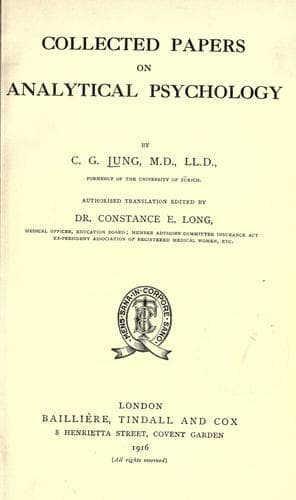
Collected Papers on Analytical PsychologyJung, C. G. (Carl Gustav)
Science
Collected Papers on Analytical Psychology
Jung, C. G. (Carl Gustav)
Psychoanalysis
this phenomenon of reactivation or secondary exaggeration of infantile
reminiscences "regression." But in Freud's conception it appears as
if the incestuous desires of the Œdipus-complex were the real cause
of the regression to infantile phantasies. If this were the case,
we should have to postulate an unexpected intensity of the primary
incestuous tendencies. This view led Freud to his recent comparison
between the so-called psychological "incest-barrier" in children and
the "incest-taboo" in primitive man. He supposes that a real incestuous
desire has led the primitive man to the invention of a protective law;
while to me it looks as if the incest-taboo is one among numerous taboos
of all sorts, and due to the typical superstitious fear of primitive
man, a fear existing independently of incest and its interdiction. I am
able to attribute as little particular strength to incestuous desires in
childhood as in primitive humanity. I do not even seek the reason for
regression in primary incestuous or any other sexual desires. I must
state that a purely sexual ætiology of neurosis seems to me much too
narrow. I base this criticism upon no prejudice against sexuality, but
upon an intimate acquaintance with the whole problem.
Therefore I suggest that the psychoanalytic theory should be liberated
from the purely sexual standpoint. In place of it I should like to
introduce an _energic view-point_ into the psychology of neurosis.
All psychological phenomena can be considered as manifestations of
energy, in the same way as all physical phenomena are already understood
as energic manifestations since Robert Mayer discovered the law of the
conservation of energy. This energy is subjectively and psychologically
conceived as _desire_. I call it _libido_, using the word in the
original meaning of this term, which is by no means only sexual.
Sallustius applies the term exactly in the way we do here: "_Magis in
armis et militaribus equis, quam in scortis et conviviis libidinem
habebant._"
Public-domain text, read in full here on John Shaqi.
Reviews
Reviews
No reviews yet
Be the first to share your thoughts on this work.
Elsewhere in the archive
Join the Discussion
Join the discussion
Sign in to leave a comment or review.
Sign InorCreate an account