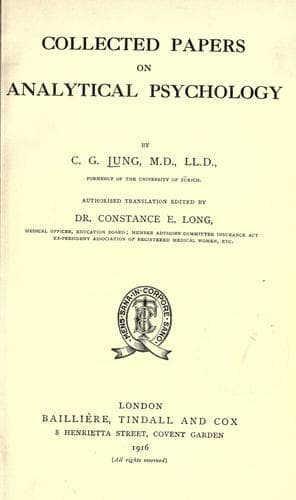
Collected Papers on Analytical PsychologyJung, C. G. (Carl Gustav)
Science
Collected Papers on Analytical Psychology
Jung, C. G. (Carl Gustav)
Psychoanalysis
Therefore I no longer find the cause of a neurosis in the past, but in
the present. I ask, what is the necessary task which the patient will
not accomplish? The whole list of his infantile phantasies does not give
me any sufficient ætiological explanation, because I know that these
phantasies are only puffed up by the regressive libido, which has not
found its natural outlet into a new form of adjustment to the demands of
life.
You may ask why the neurotic has a special inclination not to accomplish
his necessary tasks. Here let me point out that no living being adjusts
itself easily and smoothly to new conditions. The principle of the
_minimum of effort_ is valid everywhere.
A sensitive and somewhat inharmonious character, as a neurotic always
is, will meet special difficulties and perhaps more unusual tasks in
life than a normal individual, who as a rule has only to follow the
well-established line of an ordinary life. For the neurotic there is
no established way, for his aims and tasks are apt to be of a highly
individual character. He tries to follow the more or less uncontrolled
and half-conscious way of normal people, not fully realizing his own
critical and very different nature, which imposes upon him more effort
than the normal person is required to exert. There are neurotics who
have shown their increased sensitiveness and their resistance against
adaptation in the very first weeks of life, in their difficulty in
taking the mother's breast, and in their exaggerated nervous reactions,
&c. For this portion of a neurotic predisposition it will always be
impossible to find a psychological ætiology, for it is anterior to
all psychology. But this predisposition--you may call it "congenital
sensitiveness" or by what name you like--is the cause of the first
resistances against adaptation. In such case, the way of adaptation
being blocked, the biological energy we call libido does not find its
appropriate outlet or activity and therefore replaces an up-to-date and
suitable form of adaptation by an abnormal or primitive one.
Public-domain text, read in full here on John Shaqi.
Reviews
Reviews
No reviews yet
Be the first to share your thoughts on this work.
Elsewhere in the archive
Join the Discussion
Join the discussion
Sign in to leave a comment or review.
Sign InorCreate an account