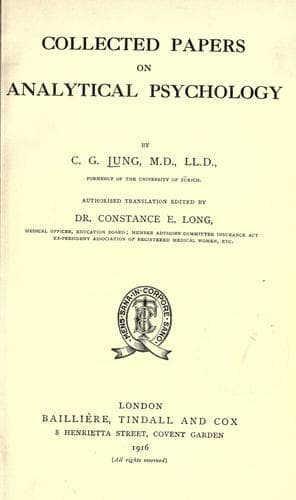
Collected Papers on Analytical PsychologyJung, C. G. (Carl Gustav)
Science
Collected Papers on Analytical Psychology
Jung, C. G. (Carl Gustav)
Psychoanalysis
In neurosis we speak of an infantile attitude or the predominance of
infantile phantasies and desires. In so far as infantile impressions
and desires are of obvious importance in normal people they are equally
influential in neurosis, but they have here no ætiological significance,
they are reactions merely, being chiefly secondary and regressive
phenomena. It is perfectly true, as Freud states, that infantile
phantasies determine the form and further development of neurosis, but
this is not ætiology. Even when we find perverted sexual phantasies of
which we can prove the existence in childhood, we cannot consider them
of ætiological significance. A neurosis is not really originated by
infantile sexual phantasies and the same must be said of the sexualism
of neurotic phantasy in general. It is not a primary phenomenon based
upon a perverted sexual disposition, but merely secondary and a
consequence of a failure to apply the stored-up libido in a suitable
way. I realize that this is a very old view, but this does not prevent
its being true. The fact that the patient himself very often believes
that this infantile phantasy is the real cause of the neurosis, does
not prove that he is right in his belief, or that a theory following
the same belief is right either. It may look as if it were so, and I
must confess that indeed very many cases do have that appearance. At all
events, it is perfectly easy to understand how Freud came to this view.
Every one having any psychoanalytic experience will agree with me here.
To sum up: I cannot see the real ætiology of a neurosis in the various
manifestations of infantile sexual development and their corresponding
phantasies. The fact that they are exaggerated and put into the
foreground in neurosis is a consequence of the stored-up energy or
libido. The psychological trouble in neurosis, and neurosis itself,
can be considered _as an act of adaptation that has failed_. This
formulation might reconcile certain views of Janet's with Freud's view,
that a neurosis is--under a certain aspect--an attempt at self-cure; a
view which can be and has been applied to many diseases.
Public-domain text, read in full here on John Shaqi.
Reviews
Reviews
No reviews yet
Be the first to share your thoughts on this work.
Elsewhere in the archive
Join the Discussion
Join the discussion
Sign in to leave a comment or review.
Sign InorCreate an account