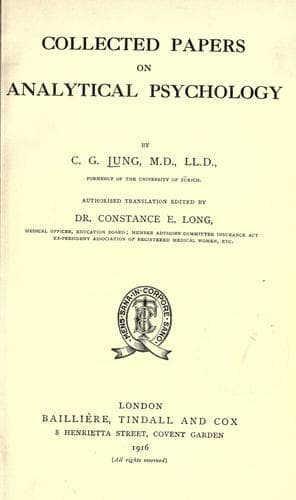
Collected Papers on Analytical PsychologyJung, C. G. (Carl Gustav)
Science
Collected Papers on Analytical Psychology
Jung, C. G. (Carl Gustav)
Psychoanalysis
To begin with, I would ask you to consider what justification there is
for the original procedure of Breuer and Freud, now entirely given up
both by Freud himself and by you, but practised by Frank, for instance,
as his only method: I mean "the abreaction of the inhibited effects
under light hypnosis." Why have you given up the cathartic method? More
particularly, has light hypnosis in psychocatharsis a different value
from suggestion during sleep, long customary in treatment by suggestion?
that is, has it only the value which the suggestionist contributes,
or does it claim to possess only the value which the patient's belief
bestows upon it? Or, again, is suggestion in the waking-state equivalent
to suggestion in hypnoidal states? This Bernheim now asserts to be
the case, after having used suggestion for many years exclusively in
hypnosis. You will tell me we must talk of psychoanalysis, not of
suggestion. But I really mean this: is not the _suggestion_, by means of
which the psychocatharsis in the hypnoidal state produces therapeutic
effects, (modified naturally, by the patients' age, etc.) the main
factor in the therapeutic success of the psychocatharsis? Frank, in
his "_Affektstörungen_," says: "these partial adjustments of effect,
suggestibility and suggestion, are almost altogether omitted in the
psychocathartic treatment in light sleep, in so far as the content of
the reproduced presentations is concerned." Is that really true? Frank
himself adds: "How can meditation upon the dreams of youth in itself
lead to the discharge of the stored-up anxiety, whether in hypnoidal
states or under any other conditions? Must one not suppose, with
much greater probability, that the anxiety-states would become more
pronounced through such concentration upon them?" [I have noticed that
myself, and much more than I at all liked.] One does indeed say to the
patient: "First we must stir up, then afterwards comes peace." And it
does come. But does it not come _in spite of the stirring-up process_,
because gradually, by means of frequent talks under light hypnosis, the
patient gets such confidence in the doctor that he becomes susceptible
to direct suggestion, and that produces at first improvement and
finally, cure? I go still further: in an analysis _in the waking-state_,
is not the patient's belief that the _method employed will cure him_,
coupled with his ever-growing trust in the doctor, a main cause of
his cure? And I ask even further: in every systematically carried-out
therapeutic treatment, is not faith in it, trust in the doctor, a main
factor in its success? I will not indeed say the only factor, for one
cannot deny that the physical, dietetic and chemical procedures, when
properly selected, have a real effect in securing a cure, over and above
the obvious effect of their indirect suggestion.
II
_From Dr. Jung._
28th January, 1913.
Public-domain text, read in full here on John Shaqi.
Reviews
Reviews
No reviews yet
Be the first to share your thoughts on this work.
Elsewhere in the archive
Join the Discussion
Join the discussion
Sign in to leave a comment or review.
Sign InorCreate an account