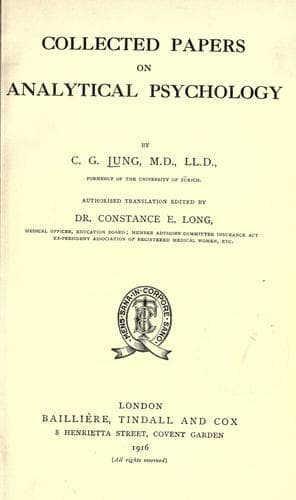
Collected Papers on Analytical PsychologyJung, C. G. (Carl Gustav)
Science
Collected Papers on Analytical Psychology
Jung, C. G. (Carl Gustav)
Psychoanalysis
Here the question arises whether it is still advisable to bring to light
all the patient's phantasies by analysis, if we now consider them as
of no ætiological significance. Psychoanalysis hitherto has proceeded
to the unravelling of these phantasies because they were considered to
be ætiologically significant. My altered view concerning the theory
of neurosis does not change the procedure of psychoanalysis. The
technique remains the same. We no longer imagine we are unearthing the
end-root of the disease, but we have to pull up the sexual phantasies
because the energy which the patient needs for his health, that is, for
his adaptation, is attached to them. By means of psychoanalysis the
connexion between the conscious and the libido in the unconscious is
re-established. Thus you restore this unconscious libido to the command
of conscious intention. Only in this way can the formerly split-off
energy become again applicable to the accomplishment of the necessary
tasks of life. Considered from this standpoint, psychoanalysis no longer
appears to be a mere reduction of the individual to his primitive sexual
wishes, but it becomes clear that, if rightly understood, it is a
_highly moral task of immense educational value_.
FOOTNOTES:
[Footnote 175: Paper given before the 17th International Medical
Congress, London, 1913.]
CHAPTER IX
ON SOME CRUCIAL POINTS IN PSYCHOANALYSIS[176]
CORRESPONDENCE BETWEEN DR. JUNG AND DR. LOY APPEARING IN
"PSYCHOTHERAPEUTISCHE ZEITFRAGEN." PUBLISHED BY DR. LOY, SANATORIUM
L'ABRI, TERRITET-MONTREUX, SWITZERLAND, 1914.
I
_From Dr. Loÿ._
12th January, 1913.
What you said at our last conversation was extraordinarily stimulating.
I was expecting you to throw light upon the interpretation of my own
and my patients' dreams from the standpoint of Freud's "Interpretation
of Dreams." Instead, you put before me an entirely new conception: the
dream as a means of re-establishing the moral equipoise, fashioned
in the realm below the threshold of consciousness. That indeed is a
fruitful conception. But still more fruitful appears to me your other
suggestion. You regard the problems of psychoanalysis as much deeper
than I had ever thought: it is no longer merely a question of getting
rid of troublesome pathological symptoms; the analysed person gets to
understand not his anxiety-experiences alone, but his whole self most
completely, and by means of this understanding he can build up and
fashion his whole life anew. But he himself must be the builder, the
Analyst only furnishes him with the necessary tools.
Public-domain text, read in full here on John Shaqi.
Reviews
Reviews
No reviews yet
Be the first to share your thoughts on this work.
Elsewhere in the archive
Join the Discussion
Join the discussion
Sign in to leave a comment or review.
Sign InorCreate an account