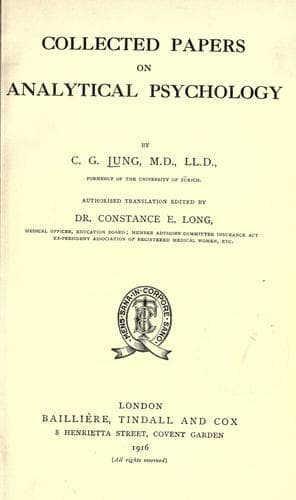
Collected Papers on Analytical PsychologyJung, C. G. (Carl Gustav)
Science
Collected Papers on Analytical Psychology
Jung, C. G. (Carl Gustav)
Psychoanalysis
As you will understand, a man possessed of scientific conscience cannot
endure such cases without embarrassment. There ripened in me the resolve
to renounce suggestion altogether rather than to allow myself passively
to be transformed into a miracle-worker. I wanted to understand what
really went on in the souls of people. It suddenly seemed to me
incredibly childish to think of dispelling an illness with charms, and
that this should be the only result of our scientific endeavours for
a psychotherapy. Thus for me the discovery of Breuer and Freud was a
veritable deliverance. I took up their method with unalloyed enthusiasm
and soon recognised how right Freud was, when at a very early date,
indeed so far back as the _Studien ueber Hysterie_, he began to direct a
searchlight upon the accompanying circumstances of the so-called trauma.
I too soon discovered that certainly some traumata with an obvious
etiological tinge are opportunely present. But the greater number
appeared highly improbable. So many of them seemed so insignificant,
even so normal, that at most one could regard them as just providing
the opportunity for the neurosis to appear. But what especially
spurred my criticism was the fact that so many traumata were simply
inventions of phantasy which had never really existed. This perception
was enough to make me sceptical about the whole trauma-theory. (But I
have dealt with these matters in detail in my lectures on the theory
of psychoanalysis).[177] I could no longer suppose that the hundred
and one cathartic experiences of a phantastically puffed-up or entirely
invented trauma were anything but the effect of suggestion. It is well
enough if it helps. If one only had not a scientific conscience and that
impulsion towards the truth! I found in many cases, especially when
dealing with more mentally gifted patients, that I must recognise the
therapeutic limitations of this method. It is, of course, a definite
plan, and convenient for the doctor, since it makes no particular
demands upon his intellect for new adaptations. The theory and practice
are both of the pleasantest simplicity: "The neurosis is caused by
a trauma. The trauma is abreacted." When the abreaction takes place
under hypnotism, or with other magical accessories (dark room, peculiar
lighting, and the rest), I remember once more the wise old woman,
who opened my eyes not merely to the magic influence of the mesmeric
gestures, but also to the essential character of hypnotism itself. But
what alienated me once for all from this relatively efficacious indirect
method of suggestion, based as it is upon an equally efficacious false
theory, was the perception I obtained at the same time that, behind the
confused deceptive intricacies of neurotic phantasies, there stands a
_conflict_, which may be best described as a _moral_ one. With this
there began for me a new era of understanding. Research and therapy
now coincided in the attempt to discover the causes and the _rational_
Public-domain text, read in full here on John Shaqi.
Reviews
Reviews
No reviews yet
Be the first to share your thoughts on this work.
Elsewhere in the archive
Join the Discussion
Join the discussion
Sign in to leave a comment or review.
Sign InorCreate an account