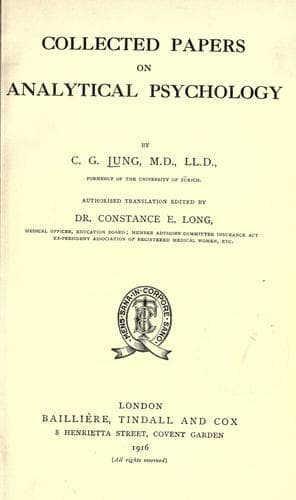
Collected Papers on Analytical PsychologyJung, C. G. (Carl Gustav)
Science
Collected Papers on Analytical Psychology
Jung, C. G. (Carl Gustav)
Psychoanalysis
solution of this conflict. That is what psychoanalysis meant to me.
Whilst I had been getting this insight, Freud had built up his sexual
theory of the neurosis, and therewith had brought forward an enormous
number of questions for discussion, all of which I thought deserved
the profoundest consideration. Thus I have had the good fortune of
co-operating with Freud for a long time, and working with him in the
investigation of the problem of sexuality in neurosis. You, perhaps,
know from some of my earlier work that I was always dubious somewhat
concerning the significance of sexuality.[178] This has now become the
exact point where I am no longer altogether of Freud's opinion.
I have preferred to answer your questions in rather non-sequent fashion.
Whatever is still unanswered, let me now repeat: _light hypnosis_ and
_complete hypnosis_ are but varying grades of intensity of unconscious
attraction towards the hypnotist. Who can here venture to draw sharp
distinctions? To a critical intelligence it is unthinkable that
suggestibility and suggestion can be excluded in the cathartic method.
They are present everywhere and are universal human attributes, even
with Dubois and the psychoanalysts who think they work on purely
rational lines. _No technique, no self-deception avails here--the
doctor works, nolens volens--and perhaps primarily--by means of his
personality, that is by suggestion._ In the cathartic treatment, what
is of far more importance to the patient than the conjuring up of old
phantasies is the being so often with the doctor, and having confidence
and belief in him personally, and in his method. The belief, the
self-confidence, perhaps also the devotion with which the doctor does
his work, are far more important things to the patient (_imponderabilia_
though they be) than the recalling of old traumata.[179]
Ultimately we shall some day know from the history of medicine
everything that has ever been of service; then perhaps at last we may
come to the really desirable therapy, to psychotherapy. Did not even
the old materia medica of filth have brilliant cures?--cures which only
faded away with the belief in it!
Because I recognise that the patient does attempt to lay hold of the
doctor's personality, in spite of all possible rational safeguards,
I have formulated the demand that the psychotherapeutist shall be
held just as responsible for the cleanness of his own hands as is the
surgeon. I hold it to be an absolutely indispensable preliminary that
the psychoanalyst should himself first undergo an analysis, for his
personality is one of the chief factors in the cure.
Public-domain text, read in full here on John Shaqi.
Reviews
Reviews
No reviews yet
Be the first to share your thoughts on this work.
Elsewhere in the archive
Join the Discussion
Join the discussion
Sign in to leave a comment or review.
Sign InorCreate an account