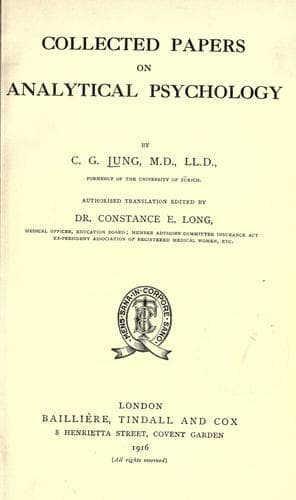
Collected Papers on Analytical Psychology — John Shaqi
Collected Papers on Analytical PsychologyJung, C. G. (Carl Gustav)
Science
Collected Papers on Analytical Psychology
Jung, C. G. (Carl Gustav)
Psychoanalysis
Projection in relation to transference--Projection of certain
attributes not explicable on the ground of personal contents, but
must be referred to the super-personal--Collective unconscious
is sediment of all the experience of the universe throughout
time--Certain features that have become prominent, _e.g._ gods
and demons, are called "dominants" and have a character of
universal psychological truth--These dominants become conscious
as projections, explaining infatuations, incompatibilities,
unconscious conflicts, etc.--The "magical demon" is the most
primitive concept of God--Analysis traces home these projections
to the non-ego--Fear belongs to the dominants of the collective
unconscious--The next step is the detachment of these projections
from the objects of consciousness--This liberates energy for
further progress--The transcendental function--The hero-myth
symbolises this differentiation of ego from non-ego.
X. THE DEVELOPMENT OF THE TYPES OF INTROVERSION AND EXTROVERSION 437
The types apprehend life by opposite methods--All psychic
images have two sides, one directed towards the object, the
other towards the soul (idea)--The feelings of the introvert
are under repression, the thoughts of the extrovert--Analytical
development of the unconscious brings out the secondary function
in each type--The pairs of opposites being thus demonstrated need
for synthesis arises--This is a compensatory process leading to
enrichment of the individual.
XI. GENERAL REMARKS ON THE THERAPY 441
The unconscious is a source of danger when the individual
is not at one with it--It also creates harmonious prospective
combinations which can be an effective source of wisdom for the
individual--The use of the phantasies in conjunction with conscious
elaboration is the transcendental function--Not every individual
passes through all the stages described--For some the end of
analysis is reached when the cure is achieved--Others are under a
moral necessity to reach a full psychological development.
CONCLUSION 443
CHAPTER XV
THE CONCEPT OF THE UNCONSCIOUS 445
I. THE DISTINCTION BETWEEN THE PERSONAL AND IMPERSONAL
UNCONSCIOUS.
Public-domain text, read in full here on John Shaqi.
Reviews
Reviews
No reviews yet
Be the first to share your thoughts on this work.
Join the Discussion
Join the discussion
Sign in to leave a comment or review.
Sign InorCreate an account