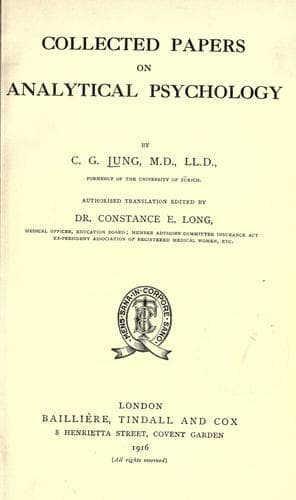
Collected Papers on Analytical PsychologyJung, C. G. (Carl Gustav)
Science
Collected Papers on Analytical Psychology
Jung, C. G. (Carl Gustav)
Psychoanalysis
Looking more closely at the fundamental grounds of your aversion to
the use of hypnosis (or semi-hypnosis, the degree matters nothing) in
_treatment by suggestion_, (which as a matter of fact every doctor
and every therapeutic method makes use of willy-nilly, no matter what
it is called), it is clear that what has disgusted you in hypnotism
is at bottom nothing but the so-called "transference" to the doctor,
which you, with your unalloyed psychoanalytic treatment, can get rid
of as little as any one else, for indeed it plays a chief part in the
success of the treatment. Your insistence that the psychoanalyst must
be answerable for the cleanness of his own hands--(here I agree with
you unreservedly)----is an inevitable conclusion. But, after all, does
anything more "augurish" really cling to the use made of hypnosis in
psychotherapeutic treatment, than to the quite inevitable use made of
the "transference to the doctor" for therapeutic ends? In either case
we must perforce "take shares" in faith as a healing agent. As for the
feeling which the patient--whether man or woman--entertains for the
doctor, is there never anything in the background save conscious or
unconscious sexual desire? In many cases your view is most certainly
correct; more than one woman has been frank enough to confess that
the beginning of hypnosis was accompanied by voluptuous pleasure.
But this is not true in all instances--or how would you explain the
underlying feeling in the hypnotising of one animal by another, _e.g._
snake and bird? Surely you can say that there the feeling of _fear_
reigns, fear which is an inversion of the libido, such as comes upon
the bride in that hypnoidal state before she yields to her husband
wherein pure sexual desire rules, though possibly it contains an
element of fear. However this may be, from your three cases I cannot
draw any ethical distinction between the "unconscious readiness towards
the hypnotist" and the "transference to the doctor" which should avail
to condemn a combination of hypnotism and psychoanalysis as a method
of treatment. You will ask why I cling to the use of hypnotism; or
rather of hypnoidal states. Because I think there are cases that can be
much more rapidly cured thereby, than through a purely psychoanalytic
treatment. For example, in no more than five or six interviews I cured
a fifteen-year-old girl who had suffered from _enuresis nocturna_ from
infancy, but was otherwise thoroughly healthy, gifted, and pre-eminent
at school: she had previously tried all sorts of treatment without any
result.
Perhaps I ought to have sought out the psychoanalytic connexion between
the enuresis and her psychosexual attitude and explained it to her,
etc., but I could not, she had only the short Easter holidays for
treatment: so I just hypnotised her and the tiresome trouble vanished.
It was a lasting cure.
In psychoanalysis I use hypnosis to help the patient to overcome
"resistances."
Public-domain text, read in full here on John Shaqi.
Reviews
Reviews
No reviews yet
Be the first to share your thoughts on this work.
Elsewhere in the archive
Join the Discussion
Join the discussion
Sign in to leave a comment or review.
Sign InorCreate an account