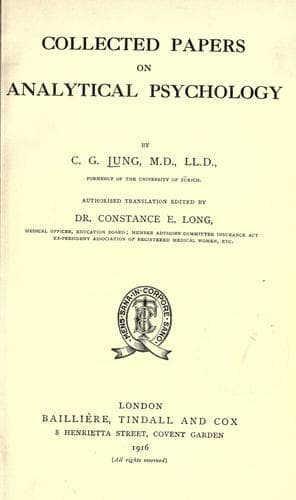
Collected Papers on Analytical PsychologyJung, C. G. (Carl Gustav)
Science
Collected Papers on Analytical Psychology
Jung, C. G. (Carl Gustav)
Psychoanalysis
Further, I use light hypnosis in association with psychoanalysis, to
hasten the advance when the "re-education" stage comes.
For example, a patient afflicted with washing-mania was sent to me after
a year's psychocathartic treatment by Dr. X. The symbolic meaning of
her washing-ceremonial was first made plain to her; she became more and
more agitated during the "abreaction" of alleged traumata in childhood,
because she had persuaded herself by auto-suggestion that she was too
old to be cured, that she saw no "images," etc. So I used hypnosis
to help her to diminish the number of her washings, "so that the
anxiety-feeling would be banished"; and to train her to throw things on
the ground and pick them up again without washing her hands afterwards,
etc.
In view of these considerations, if you feel disposed to go further
into the matter, I should be grateful if you would furnish me with
more convincing reasons why hypnotic treatment must be dispensed with;
and explain how to do without it, or with what to replace it in such
cases. Were I convinced, I would give it up as you have done, but what
convinced you has, so far, not convinced me. _Si duo faciunt idem, non
est idem._
Now I want to consider another important matter to which you alluded,
but only cursorily, and to put one question: behind the neurotic
phantasies there stands, you say, almost always (or always) a moral
conflict which belongs to the present moment. That is perfectly clear
to me. Research and therapy coincide; their task is to search out the
foundations and the rational solution of the conflict. Good. But can
the rational solution always be found? "Reasons of expediency" so often
bar the way, varying with the type of patient, for instance children,
young girls and women from "pious" catholic or protestant families.
Again that accursed opportunism! A colleague of mine was perfectly right
when he began to give sexual enlightenment to a young French patient, a
boy who was indulging in masturbation. Whereupon, like one possessed,
in rushed a bigoted grandmother, and a disagreeable sequel ensued. How
to act in these and similar cases? What to do in cases where there
arises a moral conflict between love and duty (a conflict in married
life)?--or in general between instinct and moral duty? What to do in the
case of a girl afflicted with hysterical or anxiety symptoms, needing
love and having no chance to marry, either because she cannot find a
suitable man or because, being "well-connected," she wants to remain
chaste? Simply try to get rid of the symptoms by suggestion? But that is
wrong as soon as one knows of a better way. How to reconcile these two
consciences: that of the man who does not want to confine his fidelity
to truth within his own four walls; and that of the doctor who must
cure, or if he dare not cure according to his real convictions (owing to
opportunist-motives), must at least procure some alleviation? We live
Public-domain text, read in full here on John Shaqi.
Reviews
Reviews
No reviews yet
Be the first to share your thoughts on this work.
Elsewhere in the archive
Join the Discussion
Join the discussion
Sign in to leave a comment or review.
Sign InorCreate an account