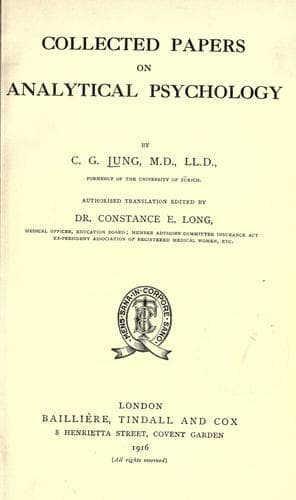
Collected Papers on Analytical PsychologyJung, C. G. (Carl Gustav)
Science
Collected Papers on Analytical Psychology
Jung, C. G. (Carl Gustav)
Psychoanalysis
When once psychoanalysis has been applied in a suitable case, it is
_imperative_ that rational solutions of the conflicts should be found.
The objection is at once advanced that many conflicts are intrinsically
incapable of solution. That view is sometimes taken because only an
external solution is thought of--and that, at bottom, is no real
solution at all. If a man cannot get on with his wife he naturally
thinks the conflict would be solved if he were to marry some one
else. If such marriages are examined they are seen to be no solution
whatsoever. The old Adam enters upon the new marriage and bungles it
just as badly as he did the earlier one. _A real solution comes only
from within, and only then because the patient has been brought to a new
standpoint._
Where an external solution is possible no psychoanalysis is necessary;
in seeking an internal solution we encounter the peculiar virtues of
psychoanalysis. The conflict between "love and duty" must be solved
upon that particular plane of character where "love and duty" are no
longer in opposition, for indeed they really are not so. The familiar
conflict between "instinct and conventional morality" must be solved
in such a way that both factors are taken satisfactorily into account,
and this is only possible through a change of character. This change
psychoanalysis can bring about. In such cases external solutions are
worse than none at all. Naturally the particular situation dictates
which road the doctor must ultimately follow, and what is then his duty.
I regard the conscience-searching question of the doctor's remaining
true to his scientific convictions as rather unimportant in comparison
with the incomparably weightier question as to how he can best help his
patient. The doctor _must_, on occasion, be able to play the augur.
_Mundus vult decipi_--but the cure is no deception. It is true that
there is a conflict between ideal conviction and concrete possibility.
_But we should ill prepare the ground for the seed of the future, were
we to forget the tasks of the present, and sought only to cultivate
ideals._ That is but idle dreaming. Do not forget that Kepler cast
horoscopes for money, and that countless artists have been condemned to
work for wages.
V.
_From Dr. Loÿ._
9th February, 1913.
The selfsame passion for truth possesses us both when we think of pure
research, and the same desire to cure when we are considering therapy.
For the scientist, as for the doctor, we desire the fullest freedom in
all directions, fullest freedom to select and use the methods which
promise the best fulfilment of their ends at any moment. Here we are at
one; but there remains a postulate we must establish to the satisfaction
of others if we want recognition for our views.
Public-domain text, read in full here on John Shaqi.
Reviews
Reviews
No reviews yet
Be the first to share your thoughts on this work.
Elsewhere in the archive
Join the Discussion
Join the discussion
Sign in to leave a comment or review.
Sign InorCreate an account