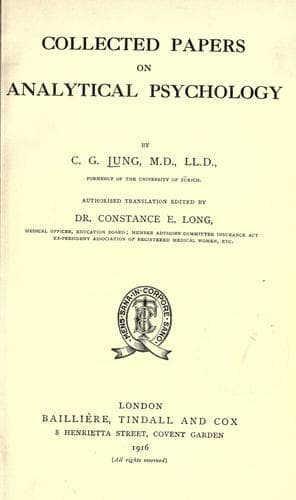
Collected Papers on Analytical PsychologyJung, C. G. (Carl Gustav)
Science
Collected Papers on Analytical Psychology
Jung, C. G. (Carl Gustav)
Psychoanalysis
First and foremost there is a question that must be answered, an old
question asked already in the Gospels: _What is Truth?_ I think clear
definitions of fundamental ideas are most necessary. How shall we
contrive a working definition of the conception "Truth"? Perhaps an
allegory may help us.
Imagine a gigantic prism extending in front of the sun, so that its
rays are broken up, but suppose man entirely ignorant of this fact. I
exclude the invisible, chemical and ultra-violet rays. Men who live
in a blue-lit region will say: "The sun sends forth blue light only."
They are right and yet they are wrong: from their standpoint they are
capable of perceiving only a _fragment_ of truth. And so too with the
inhabitants of the red, yellow, and in-between regions. And they will
all scourge and slay one another to force _their_ belief in _their_
fragment upon the others--till, grown wiser through travelling in each
others' regions, they come to the harmonious agreement that the sun
sends out light of varying colours. That comprehends more truth, but it
is not yet _the_ Truth. Only when the giant lens shall have recombined
the split-up rays, and when the invisible, chemical and heat rays
have given proof of their own specific effects, will a view more in
accordance with the facts be able to arise, and men will perceive that
the sun emits white light which is split up by the prism into differing
rays with different peculiarities, which rays can be recombined by the
lens into one mass of white light.
This example shows sufficiently well that the road to Truth leads
through far-reaching and comparative observations, the results of which
must be controlled by the help of freely chosen _experiments_, until
well-grounded hypotheses and theories can be put forward; but these
hypotheses and theories will fall to the ground as soon as a single new
observation or experiment contradicts them.
Public-domain text, read in full here on John Shaqi.
Reviews
Reviews
No reviews yet
Be the first to share your thoughts on this work.
Elsewhere in the archive
Join the Discussion
Join the discussion
Sign in to leave a comment or review.
Sign InorCreate an account