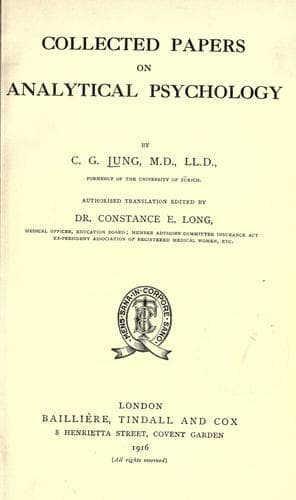
Collected Papers on Analytical PsychologyJung, C. G. (Carl Gustav)
Science
Collected Papers on Analytical Psychology
Jung, C. G. (Carl Gustav)
Psychoanalysis
And when we turn from the search for Truth back once more to
therapeutics, we see immediately that here too we are in agreement.
In practice expediency _must_ rule: the doctor from the yellow region
must adapt himself to the sick in the yellow region, as must the
doctor in the blue region, to his patients; both have the same object
in view. And the doctor who lives in the white light of the sun must
take into consideration the past experiences of his patients from the
yellow or blue region, in spite of, or perhaps rather because of, his
own wider knowledge. In such cases the way to healing will be long and
difficult, may indeed lead more easily into a _cul-de-sac_, than in
cases where he has to do with patients who, like himself, have already
come to a knowledge of the white sunlight, or, one might say, when his
patient-material has "already sorted itself out." With such sorted-out
material the psychoanalyst can employ psychoanalysis exclusively; and
may deem himself happy in that he need not "play the augur." Now, what
are these psychoanalytic methods? If I understand you aright, from
beginning to end it is a question of dealing directly and openly with
_the basic forces of the human soul_, so that the analysed person, be
he sick or sound or in some stage between--for health and sickness
flow over by imperceptible degrees into one another--shall gradually
have his eyes opened to the drama that is being acted within him. He
has to come to an understanding of the development of the hostile
automatisms of his personality, and by means of this understanding he
must gradually learn to free himself from them; he must learn, too, how
to employ and strengthen the favourable automatisms. He must learn
to make his self-knowledge real, and of practical use, to control his
soul's workings so that a balance may be established between the spheres
of emotion and reason. And what share in all this has the physician's
_suggestion_? I can scarcely believe that suggestion can be altogether
avoided till the patient feels himself really _free_. Such freedom, it
goes without saying, is the main thing to strive for, and it must be
_active_. The sick man who simply obeys a suggestion, obeys it only just
so long as the "transference to the doctor" remains potent.
But if he wishes to be able to adjust himself to all circumstances he
must have fortified himself "from within." He should no longer need the
crutches of faith, but be capable of encountering all theoretical and
practical problems squarely, and of solving them by himself. That is
surely your view? Or have I not understood correctly?
I next ask, must not every single case be treated differently, of course
_within the limits of the psychoanalytic method_? For if every case is a
case by itself, it must indeed demand individual treatment.
Public-domain text, read in full here on John Shaqi.
Reviews
Reviews
No reviews yet
Be the first to share your thoughts on this work.
Elsewhere in the archive
Join the Discussion
Join the discussion
Sign in to leave a comment or review.
Sign InorCreate an account