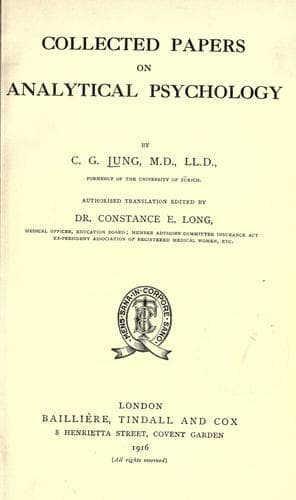
Collected Papers on Analytical PsychologyJung, C. G. (Carl Gustav)
Science
Collected Papers on Analytical Psychology
Jung, C. G. (Carl Gustav)
Psychoanalysis
The way is difficult, and in the end all man ever attains to is
_relative_ truth. But such relative truth suffices for the time being,
if it serves to explain the most important actual concatenations of the
past, to light up present problems, to predict those of the future,
so that we are then in a position to achieve adaptation through our
knowledge. But _absolute_ truth could be accessible only to omniscience,
aware of all possible concatenations and combinations; that is not
possible, for the concatenations and their combinations are infinite.
Accordingly, we shall never know more than an approximate truth. Should
new relationships be discovered, new combinations built up, then the
picture changes, and with it the entire possibilities in knowledge and
power. To what revolutions in daily life does not every new scientific
discovery lead: how absurdly little was the beginning of our first
ideas of electricity, how inconceivably great the results! Time and
again it is necessary to repeat this commonplace, because one sees
how life is always made bitter for the innovators in every scientific
field, and now is it being made especially so for the disciples of
the psychoanalytic school. Of course, every one admits the truth of
this platitude so long as it is a matter of "academic" discussion, but
only so long; just as soon as a concrete case has to be considered,
sympathies and antipathies rush into the foreground and darken judgment.
And therefore the scientist must fight tirelessly, appealing to logic
and honour, for freedom of research in every field, and must not
permit authority, of no matter what political or religious tinge, to
advance reasons of _opportunism_ to destroy or restrict this freedom;
opportunist reasons may be and are in place elsewhere, not here. Finally
we must completely disavow that maxim of the Middle Ages: "_Philosophia
ancilla Theologiæ_," and no less, too, the war-cries of the university
class-rooms with their partisanship of one or other religious or
political party. All fanaticism is the enemy of science, which must
above all things be _independent_.
Public-domain text, read in full here on John Shaqi.
Reviews
Reviews
No reviews yet
Be the first to share your thoughts on this work.
Elsewhere in the archive
Join the Discussion
Join the discussion
Sign in to leave a comment or review.
Sign InorCreate an account