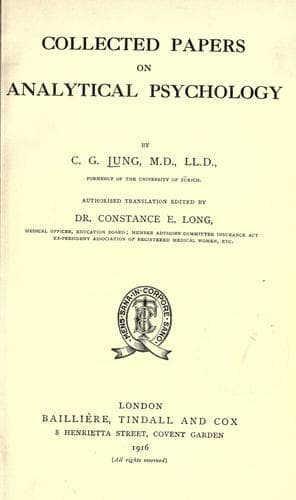
Collected Papers on Analytical PsychologyJung, C. G. (Carl Gustav)
Science
Collected Papers on Analytical Psychology
Jung, C. G. (Carl Gustav)
Psychoanalysis
You write that a solid knowledge of the psychoanalytic literature is
necessary for initiation into psychoanalysis. I should agree, but with a
certain reservation: the more one reads, the more one notices how many
contradictions there are among the different writers, and less and less
does one know--until one has had sufficient personal experience--to
which view to give adherence, since quite frequently assertions are made
without any proof. For example, I had thought (strengthened in the view
by my own experience of suggestion-therapy) that the transference to
the doctor might be an essential condition in the patient's cure. But
you write: "We psychoanalysts do not build upon the patient's faith,
rather do we have to deal with his criticism." And Stekel writes, on
the other hand (_Zentralblatt für Psychoanalyse_, 3rd year, vol. IV.,
p. 176, "Ausgänge der psychoanalytischen Kuren"): "Love for the doctor
can become a power essential to recovery. Neurotics never get well for
love of themselves. They recover out of love for the doctor. They give
him that pleasure." Here again, surely, stress is laid on the power of
suggestion? And yet Stekel too thinks he is a psychoanalyst pure and
simple. On the other hand, you say in your letter of Jan. 20th that "the
doctor's personality is one of the main factors in the cure." Should
not this expression be translated: "When the doctor inspires respect in
the patient and is worthy of his love, the patient will gladly follow
his example and endeavour to recover from his neurosis and fulfil his
human duties in the widest sense"? I think one can only emerge from
all this uncertainty by means of much personal experience, which will
indicate also which way best suits one's own personality and brings the
greatest therapeutic success. This is a further reason for undergoing
analysis oneself, to recognise fully what one is. I was decidedly in
agreement with your definition of psychoanalysis in its first (negative)
portion: psychoanalysis is neither an _anamnesis_ nor a _method of
examination_ after the fashion of a test for intelligence, nor yet
a _psychocatharsis_. In your second (positive) part, however, your
definition: "Psychoanalysis is a method of discovering the line of least
resistance to the harmonious development of the whole personality,"
seems to me valid for the patient's inertia, but not for the releasing
of the sublimated libido with a view to the new direction of life. You
consider that the neurosis causes a lack of singleness of aim in life,
because opposing tendencies hinder psychic adaptation. True, but will
not this psychic adaptation eventuate quite differently according as
the patient, when well, directs his life either to the avoidance of
pain merely (line of least resistance) or to the achievement of the
greatest pleasure?--In the first case he would be more passive, he
would merely reconcile himself "to the emptiness of reality" (Stekel,
_loc. cit._, p. 187).
Public-domain text, read in full here on John Shaqi.
Reviews
Reviews
No reviews yet
Be the first to share your thoughts on this work.
Elsewhere in the archive
Join the Discussion
Join the discussion
Sign in to leave a comment or review.
Sign InorCreate an account