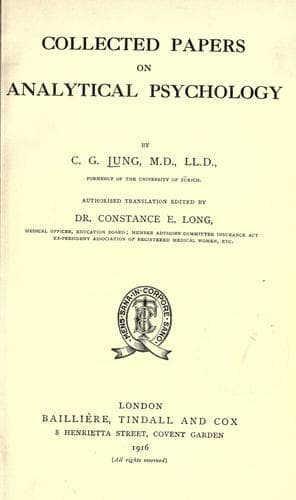
Collected Papers on Analytical PsychologyJung, C. G. (Carl Gustav)
Science
Collected Papers on Analytical Psychology
Jung, C. G. (Carl Gustav)
Psychoanalysis
In the second he would be "filled with enthusiasm"
for something or other or some person or other. But what will determine
this choice of his as to whether he will be passive rather than active
in his "second life"? In your view, will the determining factor manifest
itself spontaneously in the course of the analysis, and must the
doctor carefully avoid swaying the balance to one side or other by his
influence? Or must he, if he does _not_ renounce the right to canalise
the patient's libido in some particular direction, renounce the right
to be called a psychoanalyst, and is he to be regarded as "moderate"
or altogether as "wild"?[181] (Cf. Furtmüller, "Wandlungen in der
Freudschen Schule," _Zentralblatt für Psychoanalyse_, vols. IV., V.,
3rd year, p. 191.) But I think you have already answered this question,
since in your last letter you write: "Every interference on the part of
the analyst is a gross mistake in technique. So-called chance is the law
and the order of psychoanalysis." But, torn from its context, perhaps
this does not quite give your whole meaning. With regard to detailed
explanation of the psychoanalytic method before the beginning of the
analysis, I think you agree with Freud and Stekel: give too little
rather than too much. For the knowledge _instilled into_ a patient
remains more or less half-knowledge, and half-knowledge engenders "the
desire to know better" (than the analyst), which only impedes progress.
So, after brief explanation, first "let the patient talk," then and
there point out connexions, then after the exhaustion of the conscious
material, take dreams.
But there another difficulty confronts me which I have already pointed
out in our talks: you find the patient adapting himself to the doctor's
tone, language, jargon, whether from conscious imitation, transference,
or even resistance, when he can fight the analyst with his own weapons;
how then can you possibly prevent his beginning to produce all manner of
phantasies as supposedly real traumata of early childhood, and _dreams_
supposedly spontaneous which are in reality, though not designedly,
directly or indirectly _suggested_? I then told you that Forel ("Der
Hypnotismus") made his patients dream just what he wanted, and I have
myself easily repeated the experiment. But if the analyst desires to
_suggest nothing_, should he remain silent for the most part and let the
patient speak--except that in interpreting dreams he may lay before the
patient his own interpretation?
VIII
_From Dr. Jung._
18th February, 1913.
Public-domain text, read in full here on John Shaqi.
Reviews
Reviews
No reviews yet
Be the first to share your thoughts on this work.
Elsewhere in the archive
Join the Discussion
Join the discussion
Sign in to leave a comment or review.
Sign InorCreate an account