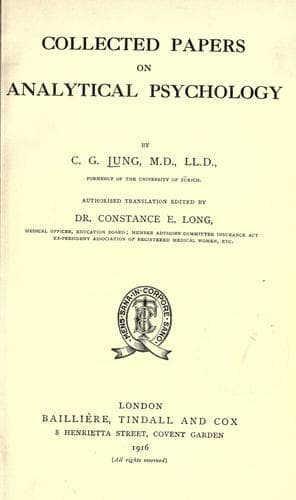
Collected Papers on Analytical PsychologyJung, C. G. (Carl Gustav)
Science
Collected Papers on Analytical Psychology
Jung, C. G. (Carl Gustav)
Psychoanalysis
only educate them to become obedient children, and thereby strengthen
the very forces that have made them ill--their conservative retardation
and their submissiveness to authority. Up to a certain point this
is the right way to take with the infantile resistance which cannot
_yet_ reconcile itself with authority. But the power which edged them
out from their retrograde dependence on the father is not at all a
childish desire for insubordination, but the powerful urge towards the
development of an individual personality, and this struggle is their
imperative life's task. Adler's psychology does much greater justice to
this situation than Freud's.
In the one case (that of infantile intractability) the positive
transference signifies a highly important achievement, heralding cure;
in the other (infantile submissiveness) it portends a dangerous
backsliding, a convenient evasion of life's duty. The negative
transference represents in the first case an increased resistance, thus
a backsliding and an evasion of duty, but in the second it is an advance
of healing significance. (For the two types, cf. Adler's "Trotz und
Gehorsam.")
The transference then is, as you see, to be judged quite differently in
different cases.
The psychological process of "transference"--be it negative or
positive--consists in the libido _entrenching itself_, as it were, round
the personality of the doctor, the doctor accordingly representing
certain emotional values. (As you know, by _libido_ I understand very
much what Antiquity meant by the cosmogenic principle of _Eros_; in
modern terminology simply "psychic energy.") The patient is bound to
the doctor, be it in affection, be it in opposition, and cannot fail to
follow and imitate the doctor's psychic adaptations. To this he finds
himself urgently compelled. And with the best will in the world and all
technical skill, the doctor cannot prevent him, for intuition works
surely and instinctively, in despite of the conscious judgment, be it
never so strong. Were the doctor himself neurotic, and inadequate in
response to the demands of the external life, or inharmonious within,
the patient would copy the defect and build it up into the fabric of his
own presentations: you may imagine the result.
Public-domain text, read in full here on John Shaqi.
Reviews
Reviews
No reviews yet
Be the first to share your thoughts on this work.
Elsewhere in the archive