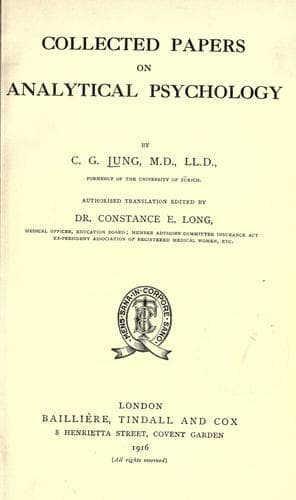
Collected Papers on Analytical PsychologyJung, C. G. (Carl Gustav)
Science
Collected Papers on Analytical Psychology
Jung, C. G. (Carl Gustav)
Psychoanalysis
At various places in your letters it has struck me that the problem
of "transference" seems to you particularly critical. Your feeling is
entirely justified. The transference is indeed at present the central
problem of analysis.
You know that Freud regards the transference as the projection of
infantile phantasies upon the doctor. To this extent the transference
is an infantile-erotic relationship. All the same, viewed from the
outside, superficially, the thing by no means always looks like an
infantile-erotic situation. As long as it is a question of the so-called
"positive" transference, the infantile-erotic character can usually be
recognised without difficulty. But if it is a "negative" transference,
you can see nothing but violent resistances which sometimes veil
themselves in seemingly critical or sceptical dress. In a certain
sense the determining factor in such circumstances is the patient's
relation to authority, that is, in the last resort, to the father. In
both forms of transference the doctor is treated as if he were the
father--according to the situation either tenderly or with hostility.
In this view the transference has the force of a resistance as soon as
it becomes a question of resolving the infantile attitude. But this
form of transference must be destroyed, inasmuch as the object of
analysis is the patient's moral autonomy. A lofty aim, you will say.
Indeed lofty, and far off, but still not altogether so remote, since it
actually corresponds to one of the predominating tendencies of our stage
of civilisation, namely, that urge towards individualisation by which
our whole epoch deserves to be characterised. (Cf. Müller-Lyer: "Die
Familie.") If a man does not believe in this orientation and still bows
before the scientific causal view-point, he will, of course, be disposed
merely to resolve this hostility, and to let the patient remain in a
positive relationship towards the father, _thus expressing the ideal of
an earlier epoch of civilisation_. It is commonly recognised that the
Catholic Church represents one of the most powerful organisations based
upon this earlier tendency. I cannot venture to doubt that there are
very many individuals who feel happier under compulsion from others than
when forced to discipline themselves. (Cf. Shaw: "Man and Superman.")
None the less, we do our neurotic patients a grievous wrong if we try
to force them all into the category of the unfree. Among neurotics,
there are not a few who do not require any reminders of their social
duties and obligations; rather are they born or destined to become the
bearers of new social ideals. They are neurotic so long as they bow down
to authority and refuse the freedom to which they are destined. Whilst
we look at life only retrospectively, as is the case in the Viennese
psychoanalytic writings, we shall never do justice to this type of case
and never bring the longed-for deliverance. For in that fashion we can
Public-domain text, read in full here on John Shaqi.
Reviews
Reviews
No reviews yet
Be the first to share your thoughts on this work.
Elsewhere in the archive
Join the Discussion
Join the discussion
Sign in to leave a comment or review.
Sign InorCreate an account