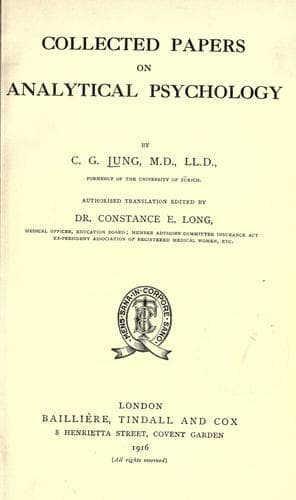
Collected Papers on Analytical PsychologyJung, C. G. (Carl Gustav)
Science
Collected Papers on Analytical Psychology
Jung, C. G. (Carl Gustav)
Psychoanalysis
This reference to the existence of an exceedingly complicated and
significant problem may suffice to explain why we by no means seldom
meet with individuals among our patients who are quite specially called,
because of their spiritual and social gifts, to take an active part in
the work of civilisation--for this they are biologically destined. We
must never forget that what to-day is deemed a moral law will to-morrow
be cast into the melting-pot and transformed, so that in the near or
distant future it may serve as the basis of a new ethical structure.
This much we ought to have learnt from the history of civilisation, that
the forms of morality belong to the category of transitory things. The
finest psychological tact is required with these critical natures, so
that the dangerous corners of infantile irresponsibility, indolence and
uncontrolledness may be turned, and a pure, untroubled vision of the
possibility of a moral autonomous activity made possible. Five per cent.
on money lent is fair interest, twenty per cent. is despicable usury.
That point of view we have to apply equally to the sexual situation.
So it comes about that there are many neurotics whose innermost delicacy
of feeling prevents their being at one with present-day morality, and
they cannot adapt themselves to civilisation as long as their moral
code has gaps in it, the filling up of which is a crying need of the
age. We deceive ourselves greatly if we suppose that many married women
are neurotic only because they are unsatisfied sexually or because they
have not found the right man, or because they still have a fixation to
their infantile sexuality. The real ground of the neurosis is, in many
cases, the inability to recognise the work that is waiting for them, of
helping to build up a new civilisation. We are all far too much at the
standpoint of the "nothing-but" psychology; we persist in thinking we
can squeeze the new future which is pressing in at the door into the
framework of the old and the known. And thus the view is only of the
present, never of the future. But it was of most profound psychological
significance when Christianity first discovered, in the orientation
towards the future, a redeeming principle for mankind. In the past
nothing can be altered, and in the present little, but the future is
ours and capable of raising life's intensity to its highest pitch. A
little space of youth belongs to us, all the rest of life belongs to our
children.
Thus does your question as to the significance of the loss of faith in
authority answer itself. The neurotic is ill not because he has lost his
old faith, but because he has not yet found a new form for his finest
aspirations.
FOOTNOTES:
[Footnote 176: Translated by Mrs. Edith Eder.]
[Footnote 177: "Psychoanalysis." Nervous and Mental Disease, No. 19.
Monograph series.]
[Footnote 178: See Author's preface to "The Psychology of Dementia
Præcox."]
Public-domain text, read in full here on John Shaqi.
Reviews
Reviews
No reviews yet
Be the first to share your thoughts on this work.
Elsewhere in the archive
Join the Discussion
Join the discussion
Sign in to leave a comment or review.
Sign InorCreate an account