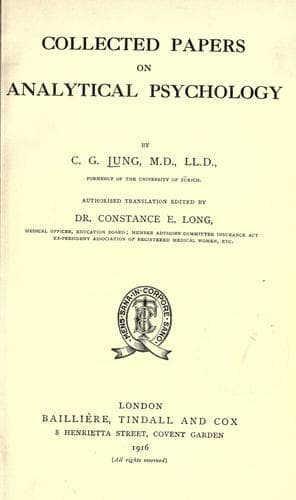
Collected Papers on Analytical PsychologyJung, C. G. (Carl Gustav)
Science
Collected Papers on Analytical Psychology
Jung, C. G. (Carl Gustav)
Psychoanalysis
[Footnote 179: Thus a patient, who had been treated by a young colleague
without very much result, once said to me: "Certainly I made great
progress with him, and I am much better than I was. He tried to analyse
my dreams. It's true he never understood them, but he took _so much
trouble_ over them. He is really a good doctor."]
[Footnote 180: Defined in the Freudian sense, as the transference to the
doctor of infantile and sexual phantasies. A more advanced conception
of the transference perceives in it the important process of emotional
approach [_Einfühlung_] which at first makes use of infantile and sexual
analogies.]
[Footnote 181: "Selected Papers on Hysteria and other Psychoneuroses."
_Monograph Series_, No. 4, last edition.]
CHAPTER X
ON THE IMPORTANCE OF THE UNCONSCIOUS IN PSYCHOPATHOLOGY[182]
When we speak of a thing as being "unconscious" we must not forget that
from the point of view of the functioning of the brain a thing may be
unconscious to us in two ways--physiologically or psychologically. I
shall only deal with the subject from the latter point of view. So that
for our purposes we may define the unconscious as "the sum of all those
psychological events which are not apperceived, and so are unconscious."
The unconscious contains all those psychic events which, because of the
lack of the necessary intensity of their functioning, are unable to pass
the threshold which divides the conscious from the unconscious; so that
they remain in effect below the surface of the conscious, and flit by in
subliminal phantom forms.
It has been known to psychologists since the time of Leibniz that the
elements--that is to say, the ideas and feelings which go to make up
the conscious mind, the so-called conscious content--are of a complex
nature, and rest upon far simpler and altogether unconscious elements;
it is the combination of these which gives the element of consciousness.
Leibniz has already mentioned the _perceptions insensibles_--those vague
perceptions which Kant called "shadowy" representations, which could
only attain to consciousness in an indirect manner. Later philosophers
assigned the first place to the unconscious, as the foundation upon
which the conscious was built.
But this is not the place to consider the many speculative theories nor
the endless philosophical discussions concerning the nature and quality
of the unconscious. We must be satisfied with the definition already
given, which will prove quite sufficient for our purpose, namely the
conception of the unconscious as the sum of all psychical processes
below the threshold of consciousness.
The question of the importance of the unconscious for psychopathology
may be briefly put as follows: "In what manner may we expect to find
unconscious psychic material behave in cases of psychosis and neurosis?"
Public-domain text, read in full here on John Shaqi.
Reviews
Reviews
No reviews yet
Be the first to share your thoughts on this work.
Elsewhere in the archive
Join the Discussion
Join the discussion
Sign in to leave a comment or review.
Sign InorCreate an account