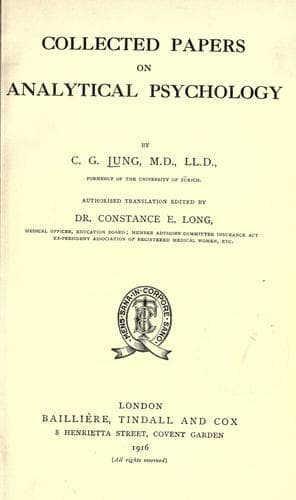
Collected Papers on Analytical PsychologyJung, C. G. (Carl Gustav)
Science
Collected Papers on Analytical Psychology
Jung, C. G. (Carl Gustav)
Psychoanalysis
He recognises the street as one down which he had walked on the previous
day. The child he acknowledges as his brother's child, whom he had seen
on the previous evening when visiting his brother. The motor accident
reminds him of an accident that had actually occurred a few days before,
but of which he had only read an account in a newspaper. Popular opinion
is known to be satisfied with this kind of explanation. People say: "Oh,
that is why I dreamt such and such a thing!"
Obviously this explanation is absolutely unsatisfactory from a
scientific standpoint. The dreamer walked down many streets on the
previous day; why was this particular one selected? He had read
about several accidents; why did he select just this one? The mere
disclosure of an antecedent is by no means sufficient; for a plausible
determination of the dream presentation can only be obtained from the
competition of various determinants. The collection of additional
material proceeds, according to the principle of recollection that
has been called the _Association Method_. The result, as will easily
be understood, is the admission of a mass of multifarious and quite
heterogeneous material, having apparently nothing in common but the fact
of its evident associative connection with the dream contents, since it
has been reproduced by means of this content.
How far the collection of such material should go, is an important
question from the technical point of view. Since the entire psychic
content of a life may be ultimately disclosed from any single starting
point, theoretically the whole previous life-experience might be found
in every dream. But we only need to assemble just so much material as
is absolutely necessary in order to comprehend the dream's meaning.
The limitation of the material is obviously an arbitrary proceeding,
according to that principle of Kant's whereby to _comprehend_ is "_to
perceive to the extent necessary for our purpose_." For instance, when
undertaking a survey of the causes of the French Revolution, we could,
in amassing our material, include not only the history of medieval
France but also that of Rome and Greece, which certainly would not be
"necessary for our purpose," since we can comprehend the historical
genesis of the Revolution from much more limited material.
Except for the aforesaid arbitrary limitation, the collecting of
material lies outside the investigator's discretion. The material
gathered must now be sifted and examined, according to principles which
are always applied to the examination of historical or any empirical
scientific material. The method is an essentially comparative one, that
obviously cannot be applied automatically, but is largely dependent upon
the skill and aim of the investigator.
Public-domain text, read in full here on John Shaqi.
Reviews
Reviews
No reviews yet
Be the first to share your thoughts on this work.
Elsewhere in the archive
Join the Discussion
Join the discussion
Sign in to leave a comment or review.
Sign InorCreate an account