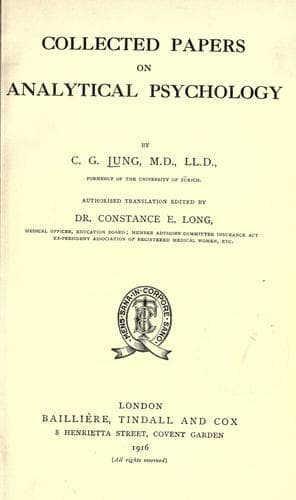
Collected Papers on Analytical PsychologyJung, C. G. (Carl Gustav)
Science
Collected Papers on Analytical Psychology
Jung, C. G. (Carl Gustav)
Psychoanalysis
As regards this point a particularly weighty argument is the fact that
Freud discovered the hidden meaning of dreams by _empiric_ and not
_deductive_ methods. A further argument in favour of a possible hidden,
as opposed to the manifest meaning of dreams, is obtained by comparing
dream-phantasies with other phantasies (day-dreams and the like) in
one and the same individual. It is not difficult to conceive that such
day-phantasies have not merely a superficial, concrete meaning, but also
a deeper psychological meaning. It is solely on account of the brevity
that I must impose upon myself, that I do not submit materials in proof
of this. But I should like to point out that what may be said about the
meaning of phantasies, is well illustrated by an old and widely diffused
type of imaginative story, of which Æsop's Fables are typical examples,
wherein, for instance, the story is some objectively impossible phantasy
about the deeds of a lion and an ass. The concrete superficial meaning
of the fable is an impossible phantasm, but the hidden moral meaning is
plain upon reflection. It is characteristic that children are pleased
and satisfied with the exoteric meaning of the story. However, the best
argument for the existence of a hidden meaning in dreams is provided
by conscientious application of the technical procedure to solve the
manifest dream content.
This brings us to our second main point, viz.--the question of analytic
procedure. Here again I desire neither to defend nor to criticise
Freud's views and discoveries, but rather to confine myself to what seem
to me to be firmly established facts.
The fact that a dream is a psychic structure, does not give us the
slightest ground for assuming that it obeys laws and designs other than
those applicable to any other psychic structure. According to the maxim:
_principia explicandi proeter necessitatem non sunt multiplicanda_, we
have to treat dreams, in analysis, just as any other psychic structure,
until experience teaches us some better way.
We know that every psychic construction considered from the standpoint
of causality, is the resultant of previous psychic contents. Moreover,
we know also that every psychic structure, considered from the
standpoint of finality, has its own peculiar meaning and purpose in the
actual psychic process. This standard must also be applied to dreams.
When, therefore, we seek a psychological explanation of a dream, we
must first know what were the preceding experiences out of which it is
combined. We must trace the antecedents of every element in the dream
picture. For example: some one dreams "_that he is walking in a street,
a child is running in front of him, who is suddenly run over by a
motor-car_." We will trace the antecedents of this dream-picture, with
the aid of the dreamer's recollections.
Public-domain text, read in full here on John Shaqi.
Reviews
Reviews
No reviews yet
Be the first to share your thoughts on this work.
Elsewhere in the archive
Join the Discussion
Join the discussion
Sign in to leave a comment or review.
Sign InorCreate an account