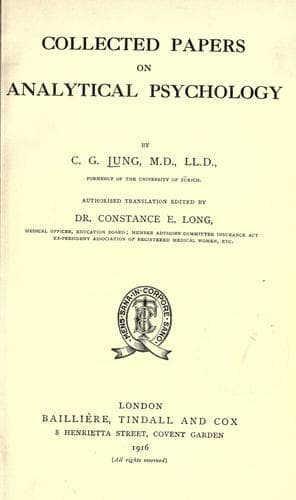
Collected Papers on Analytical PsychologyJung, C. G. (Carl Gustav)
Science
Collected Papers on Analytical Psychology
Jung, C. G. (Carl Gustav)
Psychoanalysis
In this dream we can discern a compensating function of the unconscious,
consisting in the fact that _those thoughts, propensities, and
tendencies of a human personality, which in conscious life are too
seldom recognised, come spontaneously into action in the sleeping state,
when to a large extent the conscious process is disconnected_.
The question might certainly be raised, of what use is this to the
dreamer if he does not understand the dream?
To this I must remark that to understand is not an exclusively
intellectual process, for--as experience proves--man may be
influenced--nay, even very effectually convinced--by innumerable things,
of which he has no intellectual understanding. I will merely remind my
readers of the efficacy of religious symbols.
The example given above might suggest the thought that the function
of dreams is a distinctly "moral" one. Such it appears to be in this
case, but if we recall the formula according to which dreams contain
the subliminal materials of a given moment, we cannot speak simply of
a "moral" function. For it is worthy of note that the dreams of those
persons whose actions are morally unexceptionable, bring materials to
light that might well be characterised as "immoral" in the current
meaning of that term. Thus it is significant that St. Augustine was glad
that God did not hold him responsible for his dreams. The unconscious
is the unknown of a given moment, therefore it is not surprising that
all those aspects that are essential for a totally different point of
view should be added by dreams to the conscious psychological factors of
a given moment. It is evident that this function of dreams signifies a
psychological adjustment, a compensation essential for properly balanced
action. In the conscious process of reflection it is indispensable that,
so far as possible, we should realise all the aspects and consequences
of a problem, in order to find the right solution. This process is
continued automatically in the more or less unconscious state of sleep,
wherever--as our previous experience seems to show--all those other
points of view occur to the dreamer (at least by way of allusion) that
during the day were underestimated or even totally ignored; in other
words, were comparatively unconscious.
Public-domain text, read in full here on John Shaqi.
Reviews
Reviews
No reviews yet
Be the first to share your thoughts on this work.
Elsewhere in the archive
Join the Discussion
Join the discussion
Sign in to leave a comment or review.
Sign InorCreate an account