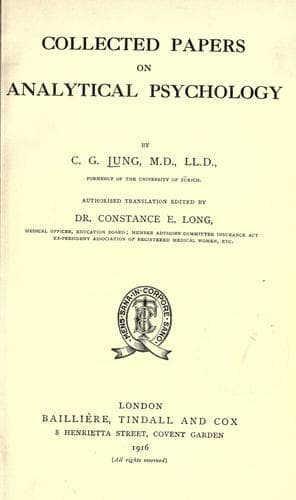
Collected Papers on Analytical PsychologyJung, C. G. (Carl Gustav)
Science
Collected Papers on Analytical Psychology
Jung, C. G. (Carl Gustav)
Psychoanalysis
As regards the much-discussed _symbolism_ of dreams, the value attached
to it varies according to whether the standpoint of causality or of
finality is adopted. According to Freud's causal view point it proceeds
from a _craving_, viz. from the suppressed dream-wish. This craving is
always somewhat simple and primitive, and is able to disguise itself
under manifold forms. For instance, the young man in question might just
as well have dreamt that he had to open a door with a key, or that he
had to travel by aeroplane, or that he was kissing his mother, etc. From
this standpoint all those things would have had the same meaning. In
this way, the typical adherents of Freud's school have come to the point
of interpreting--to give a gross instance--almost all long objects in
dreams as phallic symbols.
From the view-point of finality, the various dream pictures have each
their own peculiar value. For instance, if the young man, instead of
dreaming of the apple scene, had dreamt he had to open a door with
a key, the altered dream picture would have furnished associative
material of an essentially different character; that, again, would have
resulted in the conscious situation being supplemented by associations
of a totally different kind from those connected with the apple scene.
From this point of view, it is the diversity of the dream's mode of
expression that is full of meaning, and not the uniformity in its
significance. The causal view-point tends by its very nature towards
uniformity of meaning, that is, towards a fixed significance of symbols.
On the other hand, the final view-point perceives in an altered dream
picture, the expression of an altered psychological situation. It
recognises no fixed meaning of symbols. From this standpoint all the
dream pictures are important in themselves, each one having a special
significance of its own, to which it owes its inclusion in the dream.
Keeping to our previous example, we see that from the standpoint of
finality the symbol in this dream is approximately equivalent to a
parable; it does not conceal, but it teaches. The apple scene recalls
vividly the sense of guilt, at the same time disguising the real deed of
our first parents.
Public-domain text, read in full here on John Shaqi.
Reviews
Reviews
No reviews yet
Be the first to share your thoughts on this work.
Elsewhere in the archive
Join the Discussion
Join the discussion
Sign in to leave a comment or review.
Sign InorCreate an account