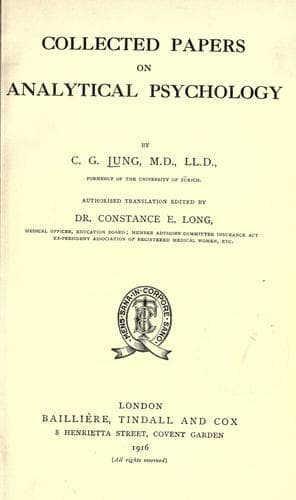
Collected Papers on Analytical PsychologyJung, C. G. (Carl Gustav)
Science
Collected Papers on Analytical Psychology
Jung, C. G. (Carl Gustav)
Psychoanalysis
I would like to treat briefly of some further problems of dream
psychology, that border on the general discussion of dreams. Firstly,
as to the _classification of dreams_; I do not wish to overestimate
either the practical or theoretical significance of this question. I
investigate yearly some 1500-2000 dreams, and this experience enables
me to state that typical dreams actually do exist. But they are not
very frequent, and from the view-point of finality they lose much
of the importance which attaches to them as a result of the fixed
significance of symbols according to the causal view-point. It seems to
me that the _typical themes_ of dreams are of far greater importance,
for they permit of a comparison with the themes of mythology. Many of
these mythological themes--in the study of which Frobenius has rendered
notable service--are also found in dreams, often with precisely the
same significance. Unfortunately the limited time at my disposal,
does not permit me to lay detailed materials before you: this has
been done elsewhere.[193] But I desire to emphasise the fact that the
comparison of the typical themes of dreams with those of mythology
obviously suggests the idea (already put forward by Nietzsche) that from
a phylogenetic point of view dream-thought should be conceived as an
older form of thought. Instead of multiplying examples in explanation
of my meaning, I will briefly refer you to our specimen dream. As
you remember, that dream introduced the apple scene as a typical
representation of erotic guilt. The gist of its purport is: "I am doing
wrong in acting like this." But it is characteristic that a dream never
expresses itself in a logically abstract way, but always in the language
of parable or simile. This peculiarity is also a characteristic feature
of primitive languages, whose flowery idioms always strike us. If you
call to mind the writings of ancient literature--_e.g._ the language of
simile in the Bible--you will find that what nowadays is expressed by
means of abstract expressions, could then only be expressed by means
of simile. Even such a philosopher as Plato did not disdain to express
certain fundamental ideas by means of concrete simile.
Just as the body bears traces of its phylogenetic development, so also
does the human mind. There is therefore nothing surprising in the
possibility of the allegories of our dreams being a survival of archaic
modes of thought.
Public-domain text, read in full here on John Shaqi.
Reviews
Reviews
No reviews yet
Be the first to share your thoughts on this work.
Elsewhere in the archive
Join the Discussion
Join the discussion
Sign in to leave a comment or review.
Sign InorCreate an account