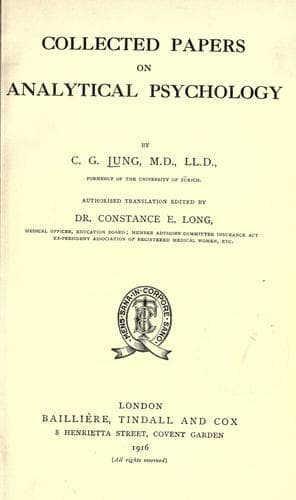
Collected Papers on Analytical PsychologyJung, C. G. (Carl Gustav)
Science
Collected Papers on Analytical Psychology
Jung, C. G. (Carl Gustav)
Psychoanalysis
It is obvious we reach very dissimilar interpretations of the meaning
of the dream, according to the point of view adopted. The question
now arises, which is the better or truer version? After all, for us
therapeuts it is a practical and not a merely theoretical necessity
that leads us to seek for some comprehension of the meaning of dreams.
In treating our patients we must for practical reasons endeavour to lay
hold of any means that will enable us to train them effectually. It
should be quite evident from the foregoing example, that the material
associated with the dream has opened up a question calculated to make
many matters clear to the young man, which, hitherto, he has heedlessly
overlooked. But by disregarding these things he was really overlooking
something in himself, for he possesses a moral standard and a moral
need just like any other man. By trying to live without taking this
fact into consideration, his life is one-sided and incomplete, so to
say inco-ordinate; with the same consequences for the psychological
life as a one-sided and incomplete diet would have for the physical.
In order to develop a person's individuality and independence to the
uttermost, we need to bring to fruition all those functions that have
hitherto attained but little conscious development or none at all. In
order to achieve this aim, we must for therapeutic reasons enter into
all those unconscious aspects of things brought forward by the dream
material. This makes it abundantly clear that the view-point of finality
is singularly important as an aid to the practical development of the
individual.
The view-point of causality is obviously more in accord with the
scientific spirit of our time, with its strictly causalistic reasoning.
Much may be said for Freud's view as a scientific explanation of dream
psychology. But I must dispute its completeness, for the psyche cannot
be conceived merely from the causal aspect, but necessitates also a
final view-point. Only a combination of both points of view--which has
not yet been attained to the satisfaction of the scientific mind, owing
to great difficulties both of a practical and theoretical nature--can
give us a more complete conception of the essence of dreams.
* * * * *
Public-domain text, read in full here on John Shaqi.
Reviews
Reviews
No reviews yet
Be the first to share your thoughts on this work.
Elsewhere in the archive
Join the Discussion
Join the discussion
Sign in to leave a comment or review.
Sign InorCreate an account